
The myth concerning the forces of creation has always been an integral part of our lives. The triad of myth-ritual-the sacred, which recurs across world cultures (as shown in the fascinating research of Mircea Eliade), today finds ancient and new forms of expression in a growing global movement of transformative festivals.
Ancient Future – The Great Initiation Journey:
Yasmine Bergner on mythical art, utopian art, and the sweeping spiritual proposition of transformative festivals.
Originally published in the online magazine Erev Rav
The identity of this emerging social movement, as reflected in the documentary series “The Bloom”, mirrors the blossoming of a global cultural renaissance. The filmmakers, Jeet K. Long and Akira Chan, show how, through ancient and new modes of expression, the triad of myth-ritual-the sacred merges in a way that reflects the era we live in — one of evolving consciousness.
Mythical art seeks to create a personal myth to guide the individual’s path and provide keys to self-discovery. This artistic trend demonstrates that it is possible to live the myth and the longing — to walk within your own legend. These emerging artists bring their persona into the public space, become visible to others, and create interaction, aiming to traverse boundaries from one space to another.
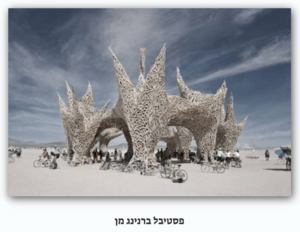
Burning Man Festival
Ideas resonating from the Earth
The festival “Faeryworlds” takes place annually in England in nature, after the first harvest — a period celebrated since ancient times. During this ancient pagan festival, people pray to the earth to remain fertile and abundant throughout the season and offer her gifts. Modern festivals like “Faeryworlds” awaken gratitude and appreciation for the universe and the abundance that sustains us.
The contemporary world and industrial revolutions have freed us from many dark sides of prejudice, yet life in a materialistic Western society — where the highest value is maximizing profit, and humans are reduced to “consumers” and “service providers”, “clients” and “bosses” — leaves many in spiritual emptiness and existential death.
We now live in a secular and rationalistic society where a process of “disenchantment”, or awakening from the mythical state, has occurred. Religions hold a monopoly over spiritual concepts and ritual boundaries. The new movement represents the longing to return to a state of enchantment, where myths are recreated through a diverse and compelling personal ritual, filling participants’ lives with content that was previously dictated to them.
The narratives we tell each other about what is “real” and “unreal” gradually lose their rigidity, partly through contemporary physical theories that collapse prior theories and challenge our perception of reality. As utopian artists, we bear the duty and responsibility to respond to this call and spread these ideas, resonating from the earth calling to us, so we can tell a new story of connection with the sacred. Myth is the tool that helps us tell this story.
Performance is one of the most powerful tools for embedding myth. This art acknowledges the deep meaning inherent in the act of creation and theatrical gesture. Connection with myth is vital to the soul and heart of the individual and to the joint creation of a new culture, welcoming artists from all creative paths.
This is a continuation of a collective narrative emerging since the dawn of history. Especially now, in the technological age, we can “pull” what is relevant to us, choose which archetype we must embody as artists, and bring the myth into performance, expressing different states of mind through dance, theater, music, and visual arts.
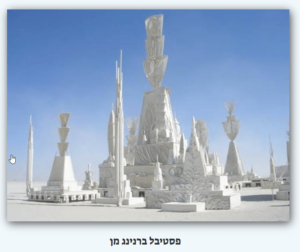
Burning Man Festival
Every person is a mirror of the sacred, an aspect of ourselves. Performance functions as a reflection of the self. The movement reconnects us with the body. Through renewed awareness of the body, there is enormous potential for transformation. Especially in an era when we are glued to computers for hours, it is vital to rethink our relationship with our body, go outside, and share what is true for us, what inspires us.
This is how spirit moves through us. We can consider ourselves fortunate that our art transforms into broader myths for our surroundings, creating collective consciousness.
One of the goals of transformative festivals is to allow internal content to be revealed and manifested externally. This trend empowers the creators and requires dismantling the master narrative. We are allowed to play, invent new myths, and engage in fully personal rituals where we connect with inner inspiration.
Myth is meant to create a mental space, a sanctuary of consciousness, for humans. The larger the story, the more it can contain. At the “Burning Man” festival, many installations conclude with a large bonfire (similar to the Israeli counterpart, the Zik group). In the apocalyptic era we live in, destruction manifests visually in many ways. Many structures collapse, and what enters next remains unclear. When something ends, space opens for surprises.
In tribal cultures, rites of passage and initiation were integral to collective culture. Today, rites of passage and initiation are almost entirely absent from our Western lives. Transformative festivals explore how rituals can restore meaning and purpose to collective experience in a non-imposing, inviting, and enabling way, offering personal and artistic freedom above all.
Tears are the river that washes the salt
Artist Paradox Folk says that ritual is “myth in practice.” Mythology embodies symbols charged with meaning, while ritual expresses how humans embody mythical perception. Ritual is a tool that brings people closer, fostering connection between self and self, self and others, and self and place — a call for the soul to rise.
Ritual focus frames attention on something experienced as important and significant beyond daily life, yet returning to it. Artist Lux Moderna seeks in transformative festivals to act as a catalyst for experiences of unity.
At a South American festival synchronized with “Burning Man”, various indigenous tribes were invited to share their ancient knowledge. Our learning is that to receive, we must give, and to give, we must learn to receive. This creates a circle of gratitude to the earth for all we receive, asking permission to be here and create space, allowing ourselves to be present and authentic, connecting from the heart with open arms regardless of background or life experiences.
As we engage in integrative internal work, we can overcome inhibitions and lift the veil from what prevents us from connecting to essence. The more we externalize beauty and truth, the more we can touch others who feel separate. The ancient essence of these festivals originates in intention; intention to sow seeds or give thanks to the heavens. Communally, this is grounding. A collective connection between heaven and earth.
Ideas that endure through history and evolution must stimulate and develop human instincts. Tragedies occur daily worldwide, yet systems do nothing to improve the situation. They do not know how. If we do not externalize our sorrow and grief, we remain blocked.
“Tears are the river that washes the salt,” says myth researcher Michael Meade. Through creating a collective and supportive community, we enable the capacity to contain and cope with grief, sorrow, and loss. We must improve our communal response to individual grief.
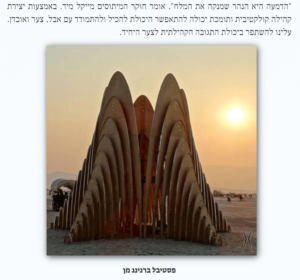
Burning Man Festival
A canon of collective consciousness leaps
A new collective narrative is emerging, defining the meaning of being human, based on an intimate connection to the source; being here and now in receptivity. This social trend moves from the more peripheral areas of society into the mainstream, into music, cinema, and visual arts. Films like “The Matrix” and “Avatar” present agendas of consciousness development and humanistic and ecological stances, serving as representatives of new artworks that have already become canonical, a canon of collective consciousness leaps in our culture.
The technological age provides us with precious gifts. All information about traditions across generations and world mythologies is accessible to us at the touch of a button. We can deconstruct and reassemble them, integrate them in ways relevant to our lives. We are undergoing a quantum leap in understanding our individuality and its power, reconnecting with the ecstatic unity of the self and the world. This trend demonstrates how prayer can become play or a daily artistic act, and that we can indeed enjoy lives of devotion.
Terence McKenna calls this trend the “Archaic Revival”; individuals relating to their community as Beloved can awaken the sacred within the community. This transformation lifts the veil from the symbols separating us from the sacred, making them more accessible.
Our connection to the sacred is actually the most essential element in our lives, whether we are aware of it or not. It is the highest way to connect as humans. If we make this connection central, it becomes the key unlocking enormous potential for expressing inner wisdom through community service.
Jeet K. Long, director of “The Bloom”, says interpersonal connection, inclusion, and inspiration propagated through transformative festivals actually express the fundamental frequencies humans need. We need these in the pragmatic society we live in to realize our potential. “Burning Man” most clearly represents this ethos.
Temples were originally mental spaces for soul healing, says the artist Shrine, creator of stunning temples/installations from waste. The temple as a concept returns to the landscape of our hearts — shared spaces of communion. We must re-sanctify art, enter it knowing nothing except our naked longing for true substance. It is an undeniable reminder of compassion. Kneeling in humility reminds us that we are all fractals of the One.
Sources:
Mircea Eliade
http://he.wikipedia.org/wiki/%D7%9E%D7%99%D7%A8%D7%A6%27%D7%94_%D7%90%D7%9C%D7%99%D7%90%D7%93%D7%94
Jeet K. Long
“The Bloom” film series
http://thebloom.tv/public/index.php/dashboard/view/25
Myth researcher Michael Meade
Lux Moderna
http://luxmoderna.bandcamp.com/
Shrine
Burning Man
http://www.burningman.com/