
דברים "חמים מהתנור"

מאמרים נוספים
A new social trend is currently emerging that warmly embraces the tattoo genre and recognizes its importance. The Tattoos exhibition presents works of art by artists from Israel and abroad who relate to the act of tattooing in various ways of expression and reveal the variety of internal motivations for tattooing in the context of defining personal, national, gender, social, cognitive and spiritual identity.
The exhibition focuses on the ancestral aspect of the tattoo. Tribal cultures are structured in concentric circles, much like the rings of a tree. The individual is situated at the center, enveloped by an outer circle surrounding them: the collective tribal system. This social circle is wrapped in yet another outer circle: the socio-religious system, which expresses the tribe’s cosmogonic and mythological worldview. The tribal totem is an archetypal visual representation of the culture—the focus and heart of the tribe—serving as a collective ancestral tool for personal and social empowerment. It attracts cellular renewal, infinite creation, and a connection between the past and the future. The totem is a dual representation: the founding male/female pair, whose pairing creates culture. The mythical graphic themes that adorn the tribal tattoo are patterns drawn from the totemic language (which is the universal grammar—the symbols and archetypes of the culture). In this context, a tattoo is a kind of “personal totem.” A talisman of memory and an object of empowerment. In the tribal world, a tattoo is part of a shamanic rite of passage and initiation, throughout the stages of life.
Since the dawn of history, the tattooed body has been a means of glorification and personal and collective definition of man. The art of tattooing has its origins in traditions of shamanic rites of passage and initiation in indigenous cultures; every tattoo work around the world contains within it pieces of culture and history and also embodies personal, social, ecological and spiritual values.
שיתוף

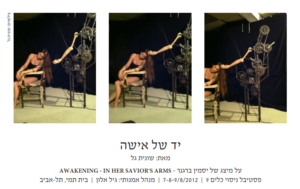
Awakening – In Her Savior’s Arms | A Performance by Yasmin Bergner

Photography & Video: Judd Moskovitz

“A Woman’s Hand” – Article by Shunit Gal

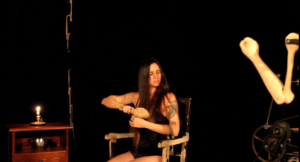
First Image:
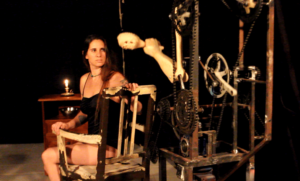
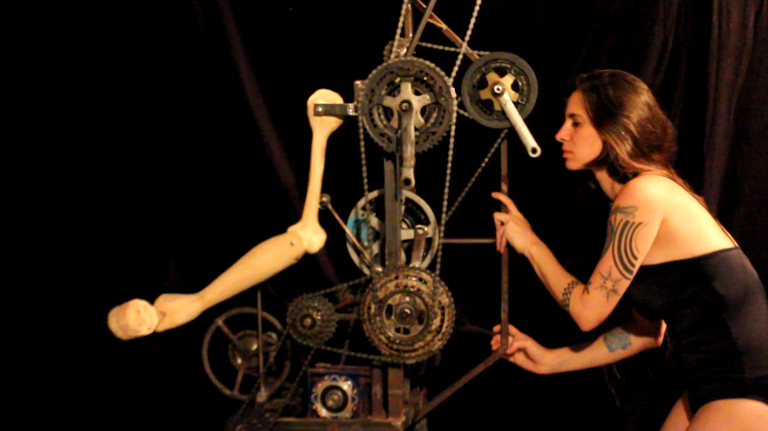
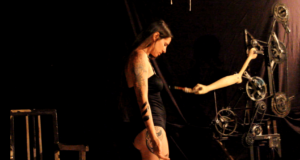
A carved wooden hand holds a brush and mechanically combs a woman’s hair. The woman sits passively during the combing process, her body leaning against the back of the chair and her head tilted to the side, while her long hair is fully spread out before the action of the machine.

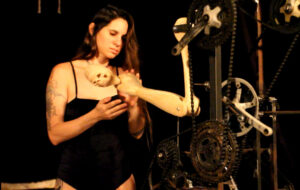
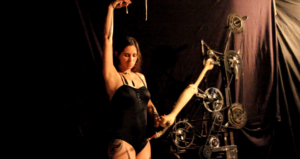
Second Image:

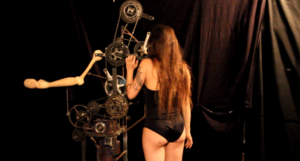
The wooden hand, now holding a tree branch like a paintbrush, awakens the seated woman to rise and become active. The artist begins to move, and a painting is created across the front of her body, while her long hair flows behind her and no longer serves as a barrier.
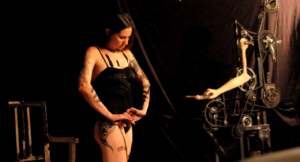
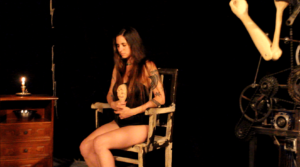
Like dream states, the two images together form the performance, appearing in a way where one precedes and intensifies the other, and both together create the complete picture.

In both situations, the woman with the long dark hair orchestrates the staged “situation room.”

In the first state, she embodies the act of combing the seductive feminine hair—both through her semi-revealing costume and through the way she sits. The woman brings herself closer to the act of combing while simultaneously distancing herself as an active/passive participant in the endless movement of time, in which women with long hair have combed and polished their locks while waiting for the sexual knight.

In the second state, she shifts the element of instinctive physicality into drawing. This time, she actively harnesses the energy of the monotonous machine for her own action. She moves her limbs so that the brush paints upon her body, like a child discovering the joy of drawing—as a revelation of liveliness and primal freedom, and as a source of abundant life.

In both states, the body is the arena in which the event unfolds. Through it and upon it, the artist tells the story without any words at all.
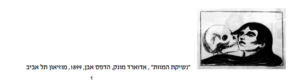
The gun that appears in the first act (the skull on the other side of the brush) contains the sexual shift that foreshadows the second act. The instinctive body is subdued (combed) in favor of the act of drawing—the artistic act—and becomes the initiation ritual the woman undergoes as she accepts the new language.

The unique hairbrush serves for the brushing action, but it is also, in itself, a small sculpted head: on one side hair, and on the other the facial bone—the skull.

In The Kiss of Death by Edvard Munch, the skull is wrapped in the woman’s long black hair, as if she is kissing it, and as if it were a twin figure from the other side.

The skull brush is an asexual image from before we are sexually differentiated (that is, before we are defined by facial identity), and it is also an image of what comes after sexuality—what remains of the body once identifying features are gone: a skull without skin or flesh.

In the performance, the artist does not give up her long, feminine hair when transitioning to the second part. The image of transformation is embodied in the brush itself. Moving from the first image to the second, the artist turns off the machine and replaces the skull brush with a branch used as a paintbrush, which she dips into color.

The imagined act of a woman being combed by a machine does not have to rely on materials of reality. It can function as an exaggeration of an image whose purpose is to dismantle the simple materials of reality—as a form of resistance and rebellion.

The machine serves as the antithesis to the woman in the performance: the instinctive, exposed female, who at one moment sits, at another rises, elusive and undefinable. The machine symbolizes rational structure—stable legs, measured time, industry, and defined rules.

Yet the practice that created the gear-driven machine is now accessible to all—and indeed, the woman can stop the machine and harness its properties.

The first time we are combed in childhood represents innocence, with parental figures meant to protect our uniqueness and childhood integrity (or not).

So what is the “flawed” or “non-conforming” element that the performance seeks to straighten through the act of hair-combing?

The hair functions as a lever between the machine and the woman—there is no longer a need to smooth it; she is already “beautiful,” and any further energy spent proving her femininity is unnecessary. Here, “beautiful” parallels “straight and orderly,” according to the standard [Comme Il Faut].

Which standard? The machine’s standard, of course. Even today, women are often expected to straighten their curls if they don’t “pass the screen” (the row of combed hairs represents a sequence of possibilities, thoughts, ideas, full potential—static energy waiting).

The monotonous state (boredom) is only possible when one side is passive. From the moment she discovers her capacity for agency, the machine’s output can no longer be uniform.

The monotonous machine fails in creation—it cannot paint.
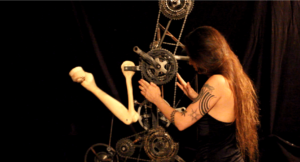
The moment of awakening is the instant she rises from the chair and begins the journey of discovery, becoming the owner of her own body.

As a reversal of the mechanical doll, “And I broke into pieces…”—the golden-haired figure in Dalia Ravikovitch’s poem—here, the tattooed artist embodies the Other. She discovers the fragments and records/displays them: the passive is also active. Even the edges of the “wall” of dark hair have a presence. The sad is also joyful.

The monotonous brush transforms into a creative paintbrush. They now mark a new territory.

The complete map is recorded through the recognition of different parts of the land—a map describing a new stage in female development.

This is the uniqueness of the work [2] Awakening – In Her Savior’s Arms: like a circular return to primordiality without relinquishing the whole female body. The complete female body is present also as an artistic image—a site of life creation and continuity, in contrast to death and the end of action.

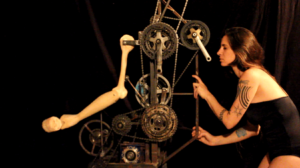
Thus, it is a woman’s hand, capable of shifting meaning in different directions. And yet, the machine [3] remains the same machine, and the woman remains the same woman. Only the meaning changes.
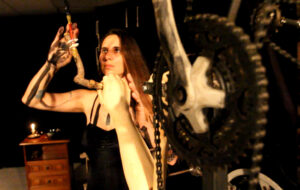
Viewing the work is highly aesthetic, akin to painterly aesthetics that return to the material. We experience both a sense of subjugation and a sense of joy and discovery, journeying with the artist with long hair through the female odyssey—a slow and precise return, leaving no detail forgotten. The knowledge she has processed along her long path becomes engraved in us, like the tattoos on Yasmin Bergner’s body [4].

A Mechanized Doll / Dalia Ravikovitch

On this night I was a mechanized doll,

And I turned right and left, to all the passersby,

And fell face down to the ground and shattered into pieces,

And they tried to mend my shards with a skillful hand.

And afterward I became a restored doll,

And all my manners were measured and obedient,

Yet by then I was already a second-type doll,

Like a bruised vine still held captive

In a trellis.

And afterward I went to dance at the ball of dances,

But they left me among cats and dogs,

And all my steps were measured and timed,

And I had golden hair and blue eyes,

And a dress colored like the flowers in the garden,

And a straw hat with a cherry decoration.
To view the full performance:
https://youtu.be/Sc3tb4yy9jg


Notes / Footnotes:

[1] The drawing line as a secret language, not yet deciphered, not yet structured.

[2] Awakening – in her Savior’s Arms is a wordplay hinting at awakening—emotional, spiritual, and sexual—as well as the symbol of the savior promised in legends, who will come to rescue the woman. Here, the SAVIOR is not the lover’s arms but the artist’s arms, which created and carved in wood, offering the possibility of self-salvation through personal creativity. ARMS refers both to arms and to a weapon. The upper part of the hand appears as bone without flesh. The skull brush was also hand-carved by the artist. The brush sits in the wooden hand like a sword in a scabbard. The skull brush also serves as a mirrored image of the tattooing artist drawing on herself.

[3] The machine, made of metal with twelve gears, stands on four metal legs and has a power on/off button.

[4] Yasmin Bergner is a tattoo artist (including tribal styles), performing slow, precise “painting” on the body using a machine, in a way that is very difficult to remove—like a memory.

Text: Shunit Gal
Photography & Video: Jude Moscovitz
2012