
Tal Gordon Interviewing Yasmine Bergner
Originally published in: Habama – Online Magazine for Art and Culture 2018
“It took me ten years to decide on my first tattoo, and fifteen minutes for the third. The permanence of the format meant I needed a long time to understand what expresses me so correctly that it will remain right forever; but the moment I knew how to phrase it, it was easy to identify the symbols that speak me precisely.”
This is likely the foundation for one of the most interesting sessions awaiting you at the “Hebrew Language Conference – Rishon LeZion” held at the Rishon LeZion Culture Hall for its 11th year. This time, the conference marks the 70th anniversary of the state and countless languages, because everything we do tells a story about us, and every such story has a language.
“Tattoos are like social networks communicating with each other, whether through genres or different tattooing practices. Sometimes it’s a message I want people to know about me, and I essentially turn myself into a work of art, a performance. It also breaks and disrupts the boundaries of normality, of the ‘matrix’ we were all born into. It’s as if I am creating my own body.”

Yasmine Bergner, Photo: Jude Moskovitz
Symbols, Words, and Messages
Over four days, from February 7 to 10, dozens of artists, singers, intellectuals, actors, lecturers, researchers, writers, and poets—(and for the sake of full disclosure, as someone for whom words are her favorite tools, I will also participate this year for the first time in one of the conference sessions)—will touch upon our various languages: from the language of the Bible to the language of the periphery, from children’s language to the language of fashion, from the language of cinema to, yes, the language of tattoos, which will be the focus of the “Tattoo of a Story” session to be held on Thursday, February 8, at 18:00.
“When people marry a symbol forever, they take physical ownership of that specific symbol and say something, either to themselves or to their environment,” says Yasmine Bergner, the session editor, one of the leading tattoo artists in the country, and the only one engaged in spiritual therapy and guidance through body art. “It’s a type of message. Tattoos are like social networks communicating with each other, whether through genres or different tattooing practices. Sometimes it’s a message I want people to know about me, and I essentially turn myself into a work of art, into a performance. It also breaks and disrupts the boundaries of normality, of the ‘matrix’ we were all born into. It’s as if I am creating my own body. It emphasizes the fact that we are a work in progress. We are constantly changing and evolving, and the body becomes a kind of life diary that changes with us.”
And the language of tattoos?
“Tattoos are a language in every sense. A tattoo is information; it essentially encodes information. Tattoos are one of the oldest arts in existence. Since the dawn of history, since ancient times, people have tattooed themselves for various reasons: as decoration and glorification of the body, as a symbol of belonging and tribal or class status, and as a tool for expressing personal and social identity.”
Which has greatly intensified in our society in recent decades, as tattooing has become almost mainstream.
“Yes, very much so in the last ten years. In the last 20–30 years, there has been a global phenomenon called the ‘Tattoo Renaissance.’ They have become an art genre in their own right, very virtuoso. Serious tattoo artists literally digest the entire history of art and ‘vomit’ them out as new genres on the body, drawing inspiration from everything possible—from etchings, classical art, design, expressionist art, everything. Also from tribal art, which is seeing a great revival worldwide, and it all merges. There is no East or West. The world is a global village.”
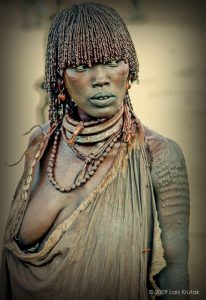
Photo: Dr. Lars Krutak, Hamar tribe scarification, Ethiopia
“Since the dawn of history, people have also tattooed themselves as a way to pass knowledge from generation to generation—of the tribal worldview, beliefs, the way tribal people perceived themselves within reality, and as a way to connect to ancient ancestors, to the hidden reality, and to guides or benevolent spirits that are actually here all the time and communicate with us. Tattoos also served as a medicinal tool, for healing the body and soul through empowering symbols, totems, and also as a type of ancient acupuncture. For instance, there are ancient mummies found with tattoos that aren’t for beauty but for healing. They correspond to acupuncture points in the body and treat various rheumatic pains.”
Tattoo Culture in Judaism
As part of the panel at the 2018 “Hebrew Language Conference,” Bergner will present the various roles of tattooing from ancient cultures to the present day, alongside Prof. Haim Maor, an expert in Talmud and the history of the Land of Israel, and Judaica artist Erik Weiss, shattering the myth that tattooing is strictly forbidden in Judaism.
“I am going to lecture on various contexts of tattoo culture within Biblical Judaism. Allegedly, we have the prohibition on tattoos in Judaism, and there is a common opinion that Jews do not get tattooed,” says Bergner, “but various studies show us that this was likely not true, and Jews in ancient times used to tattoo the names of God on themselves as part of religious worship.
“Even in the Kabbalah, there are amazing descriptions of angels who have the Torah engraved on their bodies in various places—they call them seals—and there are many mentions of writing on the body. Whether it was temporary writing or actual permanent ink, we don’t fully know, but there is a tradition of writing on the body. Even the word itself, ‘Ka’akua’ (tattoo), which is an onomatopoeia—a word whose sound reflects its meaning—links to the fact that it was an existing practice. The word is actually the sound of the tapping produced by the tattooing process with sticks hitting each other: ‘ka, ka, ka, ka.'”
“So, I will talk about various such examples. Erik Weiss, a visual graphic artist and contemporary Judaica artist whose work shows a great love for body writing and tattoos, will talk about his art, and Haim Maor, a curator and one of the veteran artists in Israel who deals in his works with his father’s Holocaust number, will lecture on the subject.”
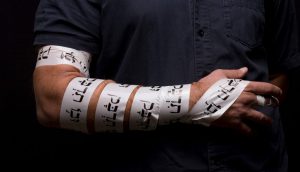
Arik Weiss, 2015
The Spiritual and Therapeutic Side
What path led you to define yourself as a spiritual guide through tattoos?
“A spiritual guide through tattoos is, in fact, a profession I developed over the years that combines all the things I know how to do best: art—I am a multidisciplinary artist; art therapy—in which I have a master’s degree and a therapeutic background; and tattoos. I went a long way from ‘Bezalel,’ through ‘Lesley College’ for art therapy studies, and then I became fascinated by tattoos. Many years later, I decided to abandon my therapeutic profession and learn to tattoo.
“After two years, because I was always drawn to spirituality and psychology, I started getting bored with just giving people tattoos without understanding who they are and without asking why they want to get that specific tattoo. I began to be a more attentive and interested tattoo artist.”
So, I also began researching the history of tattooing, thinking it would help me be a better tattoo artist, and I discovered there is an entire field of the anthropology of tattoos. For me, it was an explosion. A ‘BIG BANG,’ so to speak. I fell in love with it, and the penny dropped. I realized that this is an art so significant, so important, so close to home and close to the bone, rooted so deep in history, and that its meanings are so profound for a person—much more than some passing trend. It then became my agenda to spread this message and show people its meaning.
“I started writing articles about it and working with a therapeutic orientation. Over time, I developed my own way where I first meet the person coming to get a tattoo and try to understand what brings them to want this specific tattoo at this time in their life, how it relates to other things they are going through in other areas of life, and what they would like to receive from the tattoo on an empowerment level. Then we start designing it together, seeing which stylistic world we are drawing from, researching, and understanding the contexts so we don’t do something we don’t understand. We learn everything necessary about the tattoo, and then it truly becomes a talisman that has an impact on reality.”
Which of your tattoos do you love most?
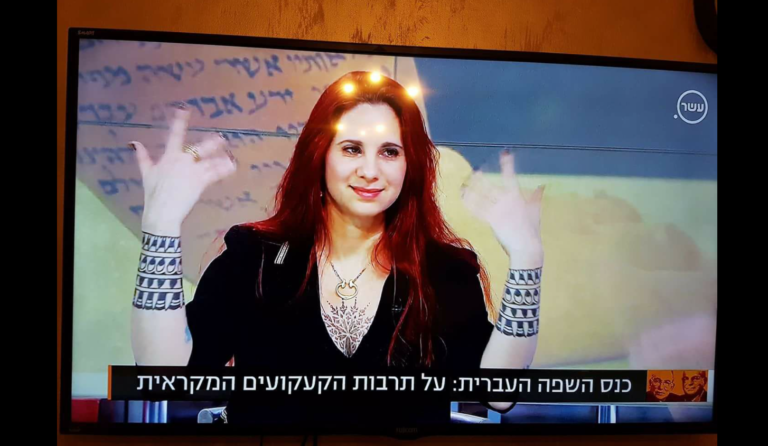
“The last ones I did. Two Egyptian-style bracelets on my wrists, because I am very connected to Egyptian culture, researching them and studying it deeply—mainly because they dealt extensively with sacred geometry, and their art was the most amazing thing in the world. After about two years as a tattoo artist, I also started two independent fields of research that I integrate into my work: one is the history of tattoos, and the second is sacred geometry.”
Am I mistaken, or does that concept lead me to the “Merkabah” shape?
“Exactly. Sacred geometry is essentially a universal path of shapes and master-patterns that create the universe, showing us that everything in the universe emerges and comes into existence through those same geometric shapes and patterns. These patterns are the result of vibrations, sound. In fact, everything is sound, and sound has a geometric shape.”

How many tattoos did you have when you started thinking of tattooing as a profession?
“I had one tattoo then, really not too many.”
And today?
“Today, it’s not expected to end.”
The 11th Hebrew Language Conference, “Lashon Rishon,” will take place on February 7–10, 2018, in Rishon LeZion.
Interview: Tal Gordon