

The act of marking is a primary means of their segregation, ostracism, expropriation, humiliation, and sometimes elimination of the marked.
These days, a fascinating exhibition curated by Chaim Maor (curator of the university galleries) in collaboration with students from the curation course, titled “Portraits of Cain – Representations of Others in Contemporary Israeli Art,” is being presented at Ben-Gurion University of the Negev.
In many ways, no one is more suitable than Maor, born in 1951, to curate a group exhibition that constitutes an additional and impressive layer of his long-standing exploration of the subject. In the opening of the catalog accompanying the exhibition, he writes that “[…] even now, as I return to this subject as a curator and teacher, I do not cease to engage with it as an artist. The figure of Cain and its incarnations, the mark of Cain, and the gazes directed at the ‘others’ are subjects of great importance, and my engagement with them has accompanied me for many years.” This curatorial approach is part of a long-term process of expanding the scope, from Maor’s interpersonal research to collective exploration of this topic in the Israeli art world, as well as a universal phenomenon.
At the same time, a large-scale solo exhibition of Maor called “They Are Me” is currently on display at the Open Museum in Omer (curator: Ruth Ofek). The exhibition reflects the broad range of the artist’s interdisciplinary work and distills the content he has been dealing with over the years. The exhibition consists of six rooms, each dedicated to a different figure connected to Maor’s life, through whom he addresses the concept of the “other.” The first room of the exhibition is dedicated to the figure of “Cain” and the mark of Cain, to the concept of the “double” / “shadow” that follows. Another room is devoted to the fragile relationship with second- and third-generation Germans post-Holocaust, the chasm between us and them, alongside the sincere effort to heal the wound through Suzanna, Maor’s German friend. Sibling rooms are dedicated to Maor’s family anthology, which is a microcosm of genocide, a genealogy of memory. Another room is dedicated to Hader and Ashah and their family, a Palestinian artist married to a Bedouin woman, and the Palestinian “other.” All the rooms together form a kind of mental map of reflection and a humanistic worldview, a sincere contemplation of the human psyche. Each room is constructed as an independent space emerging from an inner center. In the center of each room stands a central work acting as a compass (visual and ethical), and the works hanging on the surrounding walls relate to it.
Maor’s first solo exhibition, called “The Mark of Cain,” was presented in 1978 (Kibbutz Gallery, curated by Miriam Tuvia Bona). Observing his work over the years allows a better understanding of the contextual and emotional background to the exhibition “Portraits of Cain.” His pioneering body of work as a body artist since the 1970s is among the most impressive seen in Israel. Compared to the extensive American and European body art, in the 1970s only a handful of Israeli body artists worked alongside Chaim Maor, the most prominent of whom were Yocheved Weinfeld, Gideon Gechtman, Michael Druks, and Moti Mizrahi (the latter two also participate in the “Portraits of Cain” exhibition).
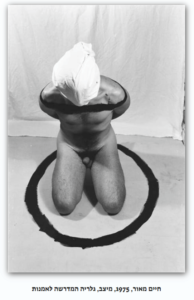
The performance works Maor created between 1975 and 1980 deal distinctly with the heavy personal traumatic legacy of a “second-generation Holocaust” artist, with representations of oppression and stigma through markings and body boundary delimitations (see my reference in the article “Bodily Ownership of the Symbol”). The family myth of Cain becomes a formative myth for large-scale and severe historical events, such as the Holocaust (Ch. Maor, from the 2012 catalog). He creates visual connections between concepts like “marking,” “victim,” and “sacrifice” through a disturbing physical presence. This breadth of meaning strengthens the understanding of social oppression as a universal human phenomenon.
“Portraits of Cain” observes the figure of Cain and the essence of the mark of Cain from multiple perspectives. This is a subject that currently arouses great interest among artists and scholars. The academic, philosophical, literary, and artistic interpretation of the biblical story is nourished by the social, political, religious, and criminal realities, in Israel and worldwide, and responds to them. Maor notes that hovering above the exhibition are the figures of social psychologist Dan Bar-On, who researched the ‘others’ within us and beside us, and the artist Michael Sgan Cohen, who offered fascinating interpretations about the figure of the artist as ‘Cain.’

Already in the Book of Genesis (Chapter 4, Verse 15), in the story of Cain and Abel, the idea of a tattoo is presented, at least conceptually: “And the Lord set a mark upon Cain, lest any finding him should kill him.” Cain becomes a wanderer, the first exile in history, as an act of punishment and atonement for the bloodshed he committed (Murder Case No. 001). The nature of the “mark” is not specified, but it likely refers to some external sign, a kind of identification meant to protect him from harm Cain fears. There is a dual meaning: the symbol is on the one hand a revealing mark of disgrace, and on the other hand, a protective symbol. Since then, the “Mark of Cain” has become an archetype symbolizing the gaze directed at the other, the ways in which society marks human beings. The act of marking is a primary means of their segregation, ostracism, expropriation, humiliation, and sometimes elimination. Many interpretations have been linked to the story of Cain and Abel, whose core is perhaps humanity’s internal struggle with the forces of good and evil within them: “If you do well, will you not be accepted? And if you do not do well, sin is crouching at the door; its desire is for you, but you must rule over it” (Genesis 4:7). Historical interpretation links the conflict to the clash between ancient agricultural culture and pastoral culture – between those settled on their land and nomads following their flocks.
It is no coincidence that the exhibition “Portraits of Cain” was accompanied by a fascinating interdisciplinary conference, inviting researchers from various fields to delve into issues of labeling and stigma, to investigate the socio-semiotic tools available to society, which create on the one hand protection and glorification, and on the other, exclusion and deprivation. The exhibition presents many such faces: Jews and Arabs, religious settlers and seculars, men and women, wanted individuals and snipers, hunters and hunted, captives, prisoners, and more. In some works, the stereotypical image is distorted, displaced, or shifted to different contexts of time and place. In some works, the artists present themselves or their characters as marked with the mark of Cain and sometimes rebel against being marked. Marking and identity, then, are complex and intricate concepts in themselves, and they accompany the works displayed in the exhibition in various ways. They shed light on social, political, religious, and gender issues present in both the works and the society in which they were created. These definitions have probably been in use since the dawn of history. The conflict arises in the encounter between different systems that oppose each other or express intolerance toward another group. In the exhibition catalog text, Maor wisely asserts that the identity of the marker is as important as that of the marked and their identifying signs.
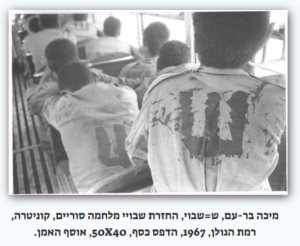
The work of Micha Bar-Am, “S = Captive,” stands out as a chilling example of identity erasure. The captives are photographed from behind, with a large black stamp in the form of the letter “S” (“Shavuy” – captive) on the back of their shirts. The captives are faceless, without identity. The mark is a decisive factor in creating the dehumanization of the marked. A glimpse over the bent bodies evokes, like a punch in the stomach, the feeling of humiliation accompanying the denial of human dignity. “S” also = “Shavur” (broken). “The work is an example of Bar-Am’s ongoing attempt to create complex and layered images, going beyond dry documentation of the subjects photographed. The camera angle exposes the viewer to the position and interpretation he gives to the situations he encounters during his work as a field photographer.”
In the work “Marking, Trade Strike, East Jerusalem,” the concepts of “marking” and “designation” receive interpretation in connection to the mark of Cain in several ways: as tangible marks meant to highlight an object (a closed shop door), or as association with a certain status (such as a prisoner of war). The letter “S” printed on the captives’ backs (resembling also a target on a shooting board) or the X inside a painted circle on a photographed iron door are powerful logo-like symbols. Bar-Am does not shy away from emphasizing the stigmatic mark in ways that evoke mixed, difficult, and provocative feelings, “similar to branding on living flesh or tattoo inscription,” in his words (Bismuth, Omer, Leibovitz, 2012).

Biblical scholar Meir Bar-Ilan points to fascinating findings revealing the existence of a Jewish tattoo culture in biblical times, providing evidence in his remarkable article “Magical Seals on the Body among Jews in the First Centuries CE” (2011). He argues that biblical tattooed individuals marked themselves with the last letter of the ancient Hebrew alphabet, which was likely the letter “X.” Simply because this was the simplest and clearest marking method. Various Torah laws were written to define what constituted a “proper” tattoo of a work of God, as opposed to a tattoo “like the gentiles.” A tattoo done for the service of God was an essential part of ritual and sacred intention before entering the mystical Merkavah vision. There is a theory that biblical Cain was tattooed with this mark. An ethnographic survey I conducted of various tribal tattoo cultures clearly shows that the “X” or “cross” symbol is the most ancient and widespread tattoo archetype in the world, originating in sun worship in ancient animistic belief systems, the cradle of religions.
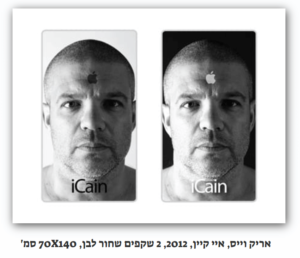
The work of Eric Weiss presents his double portrait, in positive and negative, echoing billboards. On his forehead is stamped the mark of Cain in the form of the bitten apple, the logo of the company “Apple.” The caption under the portraits, ICain, references the word iPad, the company’s flagship product. “Weiss uses the brand to divert it to a new context: from the biblical context of Cain and his punishment, he connects it to the contemporary story of enslavement to brands. The mark of Cain on his forehead – in Weiss’s work – alludes to the original sin of his parents, eating the fruit of the Tree of Knowledge. In a contemporary context, Weiss responds that ‘in today’s world, the “sinners” are branded toward themselves. They lose their inner self-personality and become part of a herd of users, worshipping their idols, external signs, and branded objects'” (Maor, 2012).
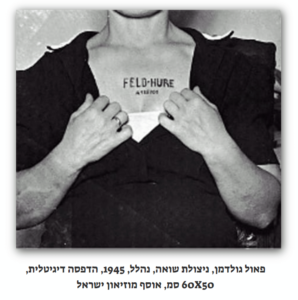
“Paul Goldman titled the photograph presented in the exhibition ‘Holocaust Survivor, Nahalal, 1945,’ but left no information about the subject, the circumstances of the photo, or its context. There is no doubt regarding the shocking power and implied meaning of the image – Jewish women in the Holocaust forced to serve as ‘field prostitutes.’ However, historically and in other respects, the photograph raises questions and no one can provide a definitive answer about it. There are hypotheses that the photo is staged. The reliability of the photograph as authentic documentation of a Holocaust survivor is undermined by the fact that the words on the woman’s chest (‘field prostitute’) are written in German as one word, Feldhure, not as two words separated by a space, as seen in the photo. Additionally, such a tattoo would be on the women’s back, not the chest. The main question is that Jewish women did not serve as field prostitutes to satisfy German soldiers or officers, since racial laws forbade any contact between Aryan men and Jewish women. ‘Field prostitutes’ were only Polish or German women. Nevertheless, this photograph is one of the most chilling artistic images in the Holocaust context” (Teshuva, Alon, Bernstein, 2012).
Among the participants in the exhibition are Asad Azi, Eyal Adler-Klener, Adi Ness, Micha Kirshner, Vardi Kahna, Vered Aharonovitch, Erez Israeli, Hader and Ashah, Michael Druks, Ken Goldman, Boaz Lanir, Assi Meshulam, Moti Mizrahi.
Quotes in the article are taken from the exhibition catalog.
“Portraits of Cain,” group exhibition, Art Gallery, Ben-Gurion University of the Negev, curators: Prof. Chaim Maor and students from the curation course, Department of Arts, April 2012 – June 2012
Chaim Maor: “They Are Me,” solo exhibition, Open Museum Omer, curator: Ruth Ofek, February 2012 – September 2012