

Contrary to popular belief, the Jews of the Biblical era maintained a rich folk tattoo culture. The prevailing opinion is that Jewish faith categorically forbids tattoos. But is this historically accurate?
The verse most often cited as proof is:
“And you shall not make any cuts on your body for the dead or tattoo yourselves: I am the Lord.” (Leviticus 19:28).
This article presents evidence that turns this assumption on its head, suggesting that in fact a folk tattoo culture existed among Biblical Jews.
“And You Shall Cleave Unto Him” – Tattoos in Judaism – An article by Yasmine Bergner
Originally published in the online magazine Erev Rav
The groundbreaking research of Biblical scholar Prof. Meir Bar-Ilan provides new insight into the subject of tattoos in the Jewish context and compiles numerous references and halachic rulings from the Bible and Hekhalot literature. These sources shed surprising new light on the phenomenon of Jewish tattooing and suggest that ancient Jews undoubtedly tattooed themselves with sacred markings as part of their devotion to God.
Already in the Book of Genesis (Chapter 4, verse 15), in the story of Cain and Abel, the idea of a tattoo appears at least conceptually:
“And the Lord set a mark upon Cain, lest any finding him should kill him.”
Cain becomes the first wanderer and exile in history, as an act of punishment and atonement for the bloodshed he committed. The nature of this “mark” is not specified, yet it was likely some external sign—an identifying mark meant to protect him from harm. The symbol carries a dual meaning: both revealing and protective at the same time (see my article “A Mark of Shame and a Symbol of Protection“).
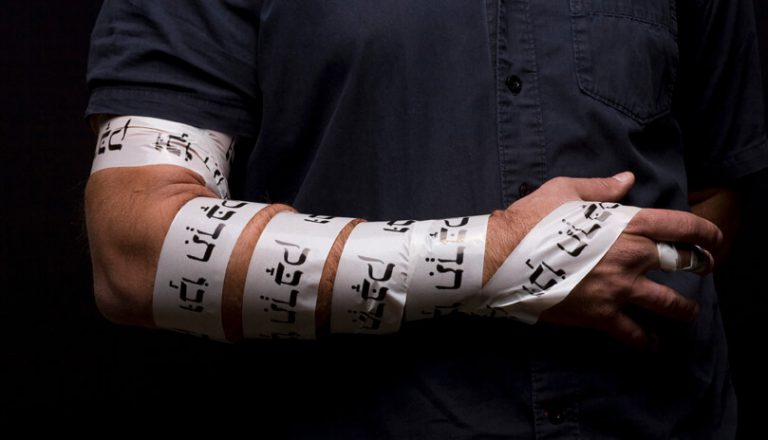
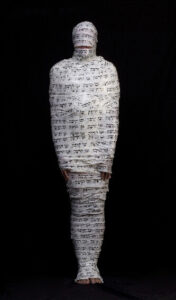
Eric Weiss, 2010, Hand Bound with Masking Tape, photograph
In the Book of Ezekiel, the idea of tattooing appears as a mark of identification and protection of the righteous in a situation reminiscent of the story of Sodom and Gomorrah. In a divine revelation experienced by the prophet Ezekiel during the Babylonian exile, far from his home, he describes:
“The Lord said to him: Pass through the city, through Jerusalem, and put a mark on the foreheads of the men who sigh and groan over all the abominations committed in it… But do not touch anyone who has the mark.” (Ezekiel 9)
The deeper meaning of the story is difficult to determine, yet seemingly Ezekiel is commanded by a mysterious divine presence appearing in the vision of the chariot to physically mark the righteous so that no harm would come to them during the destruction of the sinners.
In his foundational article “Magical Seals on the Body Among Jews in the Early Centuries CE,” Meir Bar-Ilan writes that the mark placed on people’s foreheads served as an apotropaic symbol meant to protect the righteous, similar to the blood placed on the doorposts during the Exodus from Egypt.
Bar-Ilan notes that the “sign” used to mark the righteous was likely the final letter of the ancient Hebrew alphabet, which many researchers believe resembled a cross shape (+), similar to the letter “X”. This symbol may have been chosen simply because it is the most natural form of marking: two intersecting lines.
It is also possible that the mark given to Cain was this same final letter of the ancient Hebrew alphabet (Haim Maor, 2012). The motif of the “X” tattoo appears in every tribal tattoo culture around the world without exception. It is important to note that long before the rise of Christianity, ancient humans used the iconography of the cross, whose fundamental meaning was simply the worship of the sun.
Animism represents the earliest form of belief, predating organized religion, and the sun was the purest archetype of divinity within this worldview. From it derives the shape of the X or cross: the endless rotational movement of the celestial bodies.
Bar-Ilan also suggests that members of the Qumran sect tattooed themselves with various symbols, and later Hekhalot literature clearly references the idea of sacred tattooing.
Who, then, were these ancient Jewish tattoo practitioners?
To approach a possible answer, one must understand the development of priestly traditions in the Bible. Biblical and Kabbalistic scholar Prof. Rachel Elior writes that:
“Hekhalot literature is the final link in the tradition of the mystical chariot (Merkavah), which began with Ezekiel’s chariot vision toward the end of the First Temple period in the Babylonian exile, continued in the ‘Songs of the Sabbath Sacrifice,’ angelic blessings, the Book of Enoch, the Testaments of the Tribes and many other intellectual treasures discovered in the caves of Qumran during the Second Temple period, and concluded with mystical writings known as ‘Hekhalot’ and ‘Merkavah’ composed after the destruction of the Second Temple and attributed to Rabbi Ishmael ben Elisha the High Priest and Rabbi Akiva.”
(R. Elior, p. 111)
What these traditions share is that they were written by priestly circles that were prevented from serving in the Temple due to exile, destruction, or separation from the priesthood.

Eric Weiss, 2010, Tattoo – imprinting a tefillin icon on the forehead, photograph
Changes in the meaning of tattoo cultures often occur alongside historical and political transformations. Based on the evidence, I tend to assume that the dispute regarding the legitimacy of tattooing in Biblical culture during this period arose from shifts in priestly hegemony over time. These shifts altered sacred rituals and created cultural divisions.
It is possible that the mainstream priestly traditions of that time rejected tattoo rituals and defined them as pagan practices (customs of the nations), while other priestly traditions that had been exiled, marginalized, or separated from the Temple maintained independent doctrines and philosophical approaches and made extensive use of tattooing as a shamanic act within a holistic mystical ritual.
Many texts discovered in Qumran and studied by “The Yahad Community” were unknown to us before their discovery. This community possessed a rich library of invaluable spiritual and intellectual works, and its members were engaged in study, philosophical reflection, writing, and translation. These writings later formed the foundation for Kabbalistic thought.
The nature of this group remains somewhat mysterious. In some places it is described as an idealistic and peace-seeking community living in isolation, though scholars disagree about whether it consisted of the Essenes or the Sons of Zadok.
According to Elior, we are witnessing a profound social rupture following changes in priestly leadership when authority passed from the House of Zadok to the Hasmonean dynasty. This cultural and religious conflict produced three main groups: the Sadducees, the Pharisees, and the Essenes.
The new appointment of the Hasmoneans appears as a political move not free of corruption. The Zadokite priests and the Pharisees challenged its legitimacy and criticized the unnecessary bloodshed associated with it.
This conflict reflects deeper differences in worldview and ritual practice. The new mainstream tradition followed lunar-based ritual calendars, while the marginalized priestly culture followed solar calendars and sometimes combined lunar and solar systems.
Rachel Elior points out that these three central themes—once at the heart of ancient priestly tradition and associated with celestial worship—were rejected by rabbinic tradition, marginalized, or even erased from the cultural memory preserved by later sages.
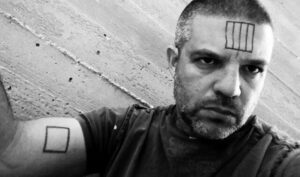
Eric Weiss, And You Shall Cleave – Self Portrait, 2010, photograph
It is therefore quite possible that certain cultural practices were excluded for political reasons through a process of canonization that elevated some traditions while suppressing others. Another possibility is that society was not ready to accept certain spiritual concepts.
The scholar Gershom Scholem spoke about the tension between mysticism and religious authority, highlighting the conflict between the mystic and the religious structures of his time.
It may be that traditions associated with ancient solar rituals were pushed aside or classified as “external literature” because they symbolized older worldviews that the new leadership sought to replace with a renewed Biblical identity.
As Scholem notes, mysticism contains two opposing yet complementary aspects: a conservative side and a revolutionary one.
Several centuries later, in Hekhalot literature, the concept of “sealing the body” appears in various forms—both regarding the design of the seal and its purpose—and takes on a dramatic character.
In the text “Ma’aseh Merkavah,” one of the most significant works of Hekhalot literature, tattooing appears as an integral element of sacred ritual. An angel explains to Rabbi Ishmael that one who seeks entry into the mystical vision must fast for forty days, eat sparingly, immerse in twenty-four ritual immersions, pray with complete devotion, and “seal himself with the seals.”
Additional references appear among the Tannaim:
“One who writes a tattoo—if he wrote but did not tattoo, or tattooed but did not write, he is not liable until he both writes and tattoos with ink, blue dye, or any substance that leaves a mark.”
Prof. Bar-Ilan interprets this in two possible ways. One interpretation is that it is forbidden to tattoo the name of God on the body, implying that a neutral tattoo is not necessarily prohibited. Another interpretation suggests that the prohibition refers not to the name of God but to the name of a foreign deity.
This indicates that ancient sages were familiar with the practice of inscribing God’s name on the body and addressed it in their legal discussions. In some cases, the halachic texts suggest that tattooing could be permitted if it functioned as an aspect of devotion to God, while tattoos related to idolatry were forbidden.
In another passage it is written that God revealed visions of hell to the disciples, who fell upon their faces, wept, and fainted for forty days and forty nights. Afterward, God raised them and “they sealed their faces.” Bar-Ilan believes that the combination of mystical vision with the sealing of the body signifies one who has experienced divine revelation.
Thus, the “sealing of the body,” as tattooing is described in Hekhalot literature, carries a clearly magical character. References indicate that these seals were placed on various parts of the body, including the forehead. The motif of the forehead tattoo in the shape of an X appears in tattoo cultures across the world.
From Rabbi Ishmael’s descriptions, it appears that the essence of the tattoo was the encoded name of God, similar to practices found in other magical traditions. According to Bar-Ilan, these tattoos functioned as “passage tickets” granting entry into the Kingdom of Heaven—in other words, initiation rites.
Rabbi Ishmael declares in the first person:
“I sealed myself with seven seals when the angel Padkars, the angel of the Presence, descended.”
The meaning of this statement remains enigmatic. What exactly were these seals? The declaration appears to arise from an authentic emotional expression and personal experience—perhaps even a trance or revelation.
These references reach their climax in the mystical work “Ma’aseh Merkavah,” which describes the heavenly gates through which the righteous pass among the angels. Those ascending through the gates must present various “seals” to the angels guarding each gate, proving their readiness and worthiness to proceed.
God sits upon His throne in the seventh palace. The mystical vision—”this great secret”—is described in concrete terms as an actual geographical space through which the initiate must pass.
Descriptions of inter-dimensional spiritual journeys appear in many traditions worldwide. The Tibetan “Bardo Thodol” (The Tibetan Book of the Dead) and the Egyptian “Book of the Dead” describe the soul’s journey from this world to the next through gates and encounters with celestial beings.
The instruction to “seal oneself” before entering the vision resembles a structured initiation ritual and closely parallels tribal tattoo traditions meant to ward off harmful spirits and summon protective ones.
The narrator of Hekhalot literature is traditionally attributed to Enoch, son of Jared, the righteous man who ascended and became the exalted angel Metatron, a being nearly divine in stature.
In the science of sacred geometry, “Metatron’s Cube” is a complex mathematical geometric form—a seal in itself—within which the Kabbalistic Tree of Life is embedded.
The “seals” worn by those who travel through the heavenly palaces serve as a means of communication with the guarding angels. The seal or tattoo functions simultaneously as a symbol of spiritual status and as a protective sign.
Later in “Ma’aseh Merkavah,” even the angels themselves are described as bearing seals:
“…and four seals of the Ineffable Name were in their hands, two at each gate.”
In the Hekhalot text “Shi’ur Komah,” which describes the “physical” form of the divine, it is explicitly written that:
“Upon His heart are written seventy names […] and upon His forehead seventy letters.”
Thus, those engaged in mystical visions in antiquity often described their Creator in their own image—and consequently sought to imitate Him. In other words, God Himself is described as having letters and sacred inscriptions embedded upon His anthropomorphic body.
Bar-Ilan provides further examples:
“Before the world was created, neither silver nor gold existed, but the Torah was written upon the arm of the Holy One, blessed be He.”
Bar-Ilan wonders why such testimonies have not received deeper attention among rabbinic scholars. In her book Memory and Oblivion, Rachel Elior seeks to recover the voices of the “forgotten, silenced, marginalized, and defeated” whose sacred library was discovered in the caves of Qumran by the Dead Sea—voices that had almost entirely disappeared from Jewish history and collective memory for nearly two thousand years.
According to these testimonies, there is reasonable ground to believe that a Biblical tattoo culture once existed and later faded from cultural consciousness alongside these historical developments.
I would like to thank Prof. Meir Bar-Ilan.
Yasmine Bergner is an artist, a spiritual guide through tattooing, and a researcher.