
In the exhibition addressing American tattoo culture, photographer Rona Yifman continues to observe personas operating under a sense of oppression, revealing a humanity that transcends social definitions.
To Experience Pain in a Controlled Way – by Yasmine Bergner
Originally published in the online magazine Erev Rav, 2012
TUFF ENUFF – On the Solo Exhibition of Photographer Rona Yefman
Zomer Gallery, Tel Aviv, 2012
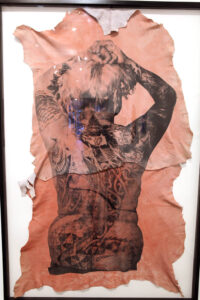
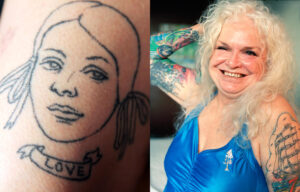
Photographer Rona Yefman, currently presenting a solo exhibition at Zomer Gallery, created a series of works in video, photography, and print on various materials, sewing on textiles and leather, and neon sculpture, uniquely exploring the lives and personas of two American tattoo artists. One of them is “Shanghai Kate”, a 65-year-old renowned American tattoo artist, an iconic figure in the history of American tattooing, active in the tattoo scene since the 1960s in the old-school genre (sailor and military tattoos). The other is Caitlin, a 20-year-old New York artist who tattoos herself at home as an amateur.
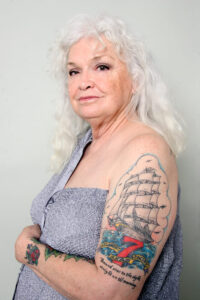
Yefman explains that a subconscious impulse causes her to be “magnetized” to a person, turning them, for a period, into the subject of her artistic investigation. Her focus on the unique personas of these two women expresses a deep and empathetic observation that arises organically from the interaction and intimacy created between them. “The photographs of ‘Shanghai Kate’ were taken during nine intense days we spent together. I came to the hotel room every day to photograph her,” Yefman says. “The initial encounter with Shanghai Kate and Caitlin was a chance meeting in the New York subway. I saw the tattooed arm of an older woman as a storm of hair, and a certain impulse made me start a conversation with her.” Yefman says that tattooing is not necessarily the main essence of the works, but an opportunity to connect with people (as with any other subject of her artistic investigation). She shoots at eye level, does not elevate herself above her subjects or impose a private worldview, but is present as an enabling figure, observing with empathy and full acceptance, without judgment or interpretation.
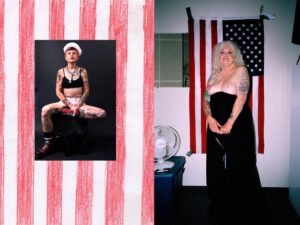
“Only when Caitlin came to my studio and removed her long shirt because it was hot that day did I notice her tattoos… This was about a year after photographing Shanghai Kate. When I had the materials of both women, it felt right to connect the two sets, and something happened that complemented each other,” she recounts. Indeed, the exhibition surprisingly and naturally combines two worlds. The photographs reveal coherent and complete figures. Fragile and vulnerable, yet possessing a strong center and clear identity. They are so human, intriguing, shining with the light of their unique personality, strong and vulnerable at the same time. They also resonate profoundly with questions of self-image and the perception of the “self” in relation to the world. The video work of “Shanghai Kate” focuses on the tattoo artist lying on a bed, smiling a weary and tough smile while talking about her life.
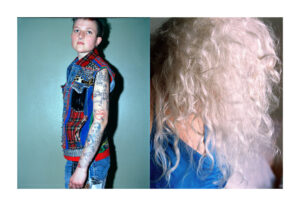
It points to a fundamental feeling accompanying her throughout her life, of being subjected to oppression and struggle as a female tattoo artist, a rare situation in 1960s New York in a male-dominated field. She describes a competitive and challenging career from which she forgoes motherhood. Her struggle as a woman among men, and her strong ambition to succeed and overcome difficulties, finds artistic expression in a biker-style denim jacket sewn by Yefman. On the back of the jacket, Yefman imprinted Shanghai Kate’s “manifesto,” starting with the words “I’M A BORN FIGHTER.” As a mental action, there is a connection between tattooing and sewing, and between tattooing and imprinting color on textile. The needle penetrates the skin, sews the fabric, wounding and healing simultaneously.
Another powerful work is a striking close-up photograph of a tattoo on the skin of the young tattooer Caitlin, a tattoo she created and signed herself. It is an almost enigmatic text saying: TIME KILLS, framed within a lightbox. The light emanating from the box seems to “illuminate” the skin from within, creating transparency. The viewer receives a close-up of the tattoo, almost as if looking into the skin itself. In a nearby video work, Yefman’s camera focuses on a similar close-up. Viewers watch Caitlin tattoo herself in real time, as if they were in the room with her while she holds the needle (usually inside a tattoo machine) in a decisive hand, unaware of the pain.
She stretches the skin with one finger and tattoos with the other, pressing repeatedly and inserting the color-filled needle into the skin, creating dots that eventually merge into lines. With great determination, she traces symbols on the human skin, as if immersed in a private ritual. Intimate therapy through pain. She sketches a personal manifesto: a broken heart with “OVER & OVER” inscribed in the skin below it. She tattoos on herself her life, her fate as she perceives it, in the privacy of her home.
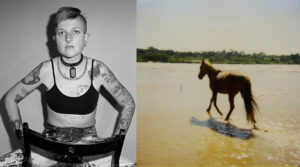
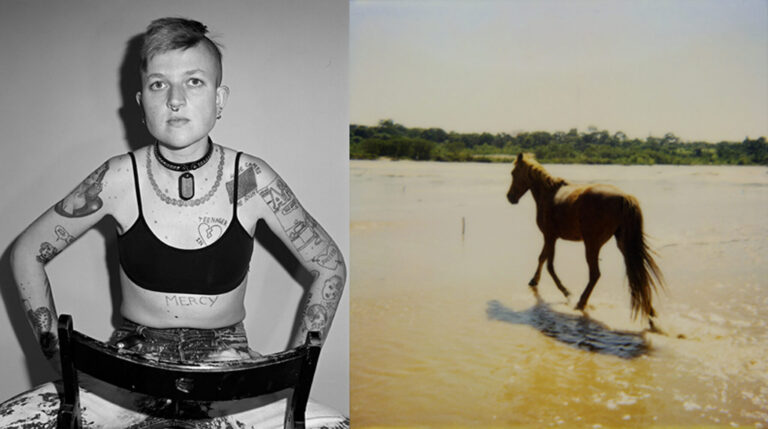
Caitlin’s face, with her giant childlike eyes and shy, quiet body language, radiates fragility and insecurity, yet self-acceptance and serenity. She is presented to the viewer in all her humanity, and even beyond. Rona Yefman creates a kind of “restoration” where these two women, who perceive themselves as “outsiders” and have undergone a certain type of social oppression, are given a place of “honor” and recognition of their humanity (and as artists!), presented in the sterile gallery space and subversively returned to the consensus. This is characteristic of Rona Yefman’s work throughout her career, consistent in her interactive observation of the “other” and the different.
Tattooed individuals, as young Caitlin demonstrates, are people willing to “experience pain in a controlled way”. One role of the tattoo artist is to help the client moderate impulses related to pain and harm. Even today, the act of tattooing is an act of symbolic pain operating on two levels: physically, it is a form of “pain therapy,” ventilating excess or lack of sensory stimulation. Psychologically, it is a physical action refining impulses. Its purpose is to “guide” and elevate beyond everyday life. It is also an opportunity to reinvent oneself, to create a personal identity the individual can embrace while marking themselves with their own archetypes and personal mythology. After all, the body is both the marker and the marked.
Although the two women in Rona Yefman’s exhibition come from different backgrounds and belong to different generations, both resonate with the American history of tattoo culture. In the Bowery neighborhood of New York, a tattoo culture flourished, originating from France in the early 20th century and lasting until the 1960s, as a marginalized subculture compared to mainstream culture. It was a meeting place for rebels, criminals, sailors, and prostitutes. On the streets near where the Chrysler building now stands, one can still sense the era’s atmosphere. Didier Anzieu’s significant book, *The Skin Ego*, helps understand the tattoo phenomenon in its proper psychological context. In his research, Anzieu claims that a person’s primary sense of identity is formed through the consciousness of the “skin ego”—a psychological envelope through which one experiences the world. “By directing attention to the skin as both a primary, organic, and simulated medium, it functions as the individual’s protective system and simultaneously as the first tool and exchange space with others” (p. 43).
“The ‘Skin Ego‘ envelope is a psychological envelope (like other envelopes related to smell, memory, dream, etc.), oriented simultaneously inward and outward. It develops properly only if the mother expresses something of herself and the child, related to the quality of the child’s emotional experiences” (p. 35). These psychological imprints influence lifelong aesthetic and ethical choices regarding body image, expressed in harmony versus disharmony, compositional perception, and geometric balance relative to the body, or in contrast, creating dissonance or formal chaos. The tattoo ritual serves as an alternative means of coping with psychological content, and although it is not commonly recognized in the West, tattoos are catalysts for development.
Through the tattooed image, the tattooed person creates a memory pattern that helps bring psychological content to the surface, literally. Once a certain image is imprinted on the skin, it is there to stay, representing a desire to create something eternal in the world. Rona Yefman sees the tattoos of Kate and Caitlin as deeply personally meaningful. The “ship” tattoo on Shanghai Kate’s shoulder, shown in one portrait, is a tattoo she “earned” from a colleague after years of resistance to her work. Caitlin regards her body as a “journal” or “sketchbook,” as Yefman explains, on which she writes and draws. Like a parchment scroll, it narrates her life circumstances and personal insights, which, through Yefman’s lens, become poetic. In a beautiful photograph printed on textile resembling a red-striped flag, somewhat echoing the United States flag, Yefman photographed Caitlin as a sailor directly engaging with this specific subculture and its history.
The act of tattooing involves dual exposure. First, the tattooed person “reveals” to themselves, consciously or unconsciously, hidden content, dark material usually concealed from view. Second, on a collective level, the tattooed individual displays their tattoos, symbolizing, for the conservative observer, an “improper disclosure” of content they themselves do not wish to explore. The very nature of the tattooed person as outside the mainstream is threatening. This is why Western culture stigmatized tattoos. They represent inappropriate visibility, and certain arts are only accepted after rebellion or a long evolutionary period, after which society could assimilate innovations safely. In her exhibition, Yefman continues her work exploring “others,” human personas who demonstrate courageous paths, not necessarily mainstream. People operating from social oppression or striving for individualism ultimately reveal humanity that transcends social definitions.
Rona Yefman TUFF ENUFF
Zomer Gallery, March–April 2012
Yasmine Bergner is an artist, spiritual guide through tattoos, art therapist and researcher