
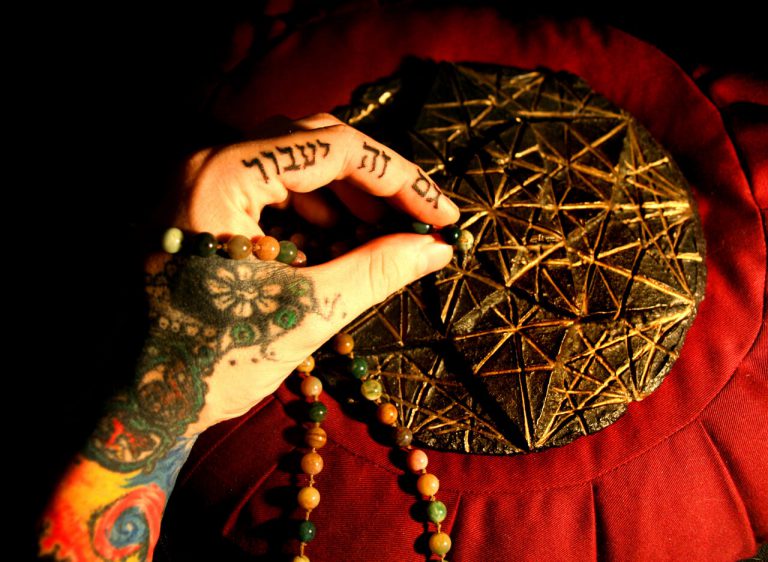
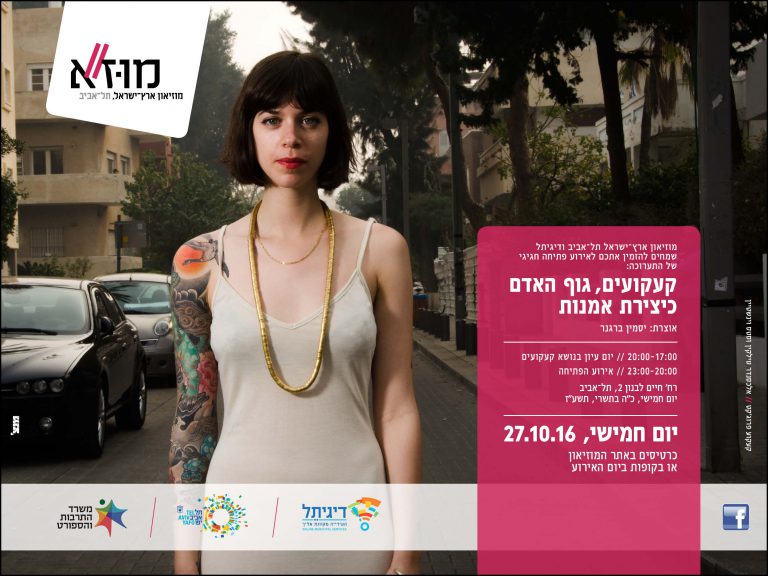
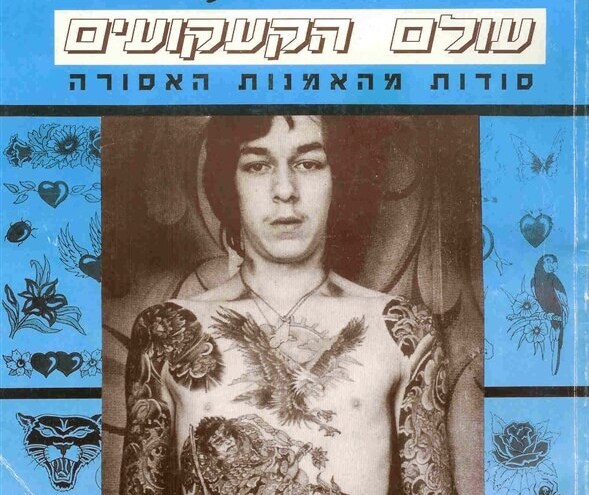

A new social trend is currently budding, warmly embracing the tattoo genre and recognizing its importance. The exhibition presents artworks by artists from Israel and abroad who address the act of tattooing in various ways, revealing the diverse internal motives for getting a tattoo within the contexts of defining personal, national, gender, social, cognitive, and spiritual identities.
Participating artists include: Ron Amir, Rona Yefman, David Adika, Guy Briller, Raya Bruckenthal, Vardi Kahana, Meir Gal, Esther Cohen Skin, Lars Krutak, Assi Meshullam, Arik Weiss, Daniel Cohen Diner, and others.
Opening image: Malkiela Ben Shabat and Dan Belilty
Research: Yasmine Bergner
Curators: Yasmine Bergner and Haim Maor
5/11/13 at 18:00 until 14/1/14, The Senate Gallery at the George Soros Visitor Center, the Samuel and Milda Ayerton University Center, Department of the Arts, Ben-Gurion University of the Negev.

Dafna Shapira Hasson and Shunit Gal in a special performance for the exhibition
From the exhibition catalog:
In tribal cultures, the art of tattooing was always an inseparable part of the culture. Until the end of the 19th century, in Western culture, the art of tattooing was almost completely ignored and was perceived as an “inferior” and “decadent” genre, linked to diagnoses of criminal tendencies.
In recent years, Western society has been opening up to the art of tattooing. Its status as an independent artistic genre is increasingly becoming established after being labeled for centuries as an “inferior” fringe culture. Today, a new social trend is budding, warmly embracing the tattoo genre and recognizing its importance.
What is the impulse that leads to the engraving of a “message” on the skin, to a “marriage” or a “covenant” between body and ideology?
The personal body and its relationship with the “Social Body”—a term coined by Michel Foucault in 1977—is the focus of observation when we come to examine the universal phenomenon of tattooing. The body constitutes the source of our personal identity and the foundation from which we identify ourselves as a separate entity. The body is the medium through which the self communicates with the ‘other’. We create personal identities, upon which social relationships are based. The modification and manipulation of the body through tattooing can be interpreted as an active engagement with self-identity and with positioning ourselves within our social relationships.
Various social revolutions and post-modern life have defined and are redefining values of “individualism,” “subject,” and the “private body.”
Vardi Kahana
Culture and gender researcher Elizabeth Grosz argues that the “authentic” body, in contrast to the “docile body” defined by Foucault, does not surrender to external dictates of regulation, surveillance, and restriction, but rather to empowered internal dictates, to self-management and self-control. The body does not obey out of respect for authority, but out of dedication to will, desire, and consciousness. Post-modernist perceptions that have recently reached maturity manage to formulate in a complex and clear way a feminist philosophical discourse that does justice to the terms “body” and representations of the “self.” In recent years, feminist discourse has managed to relate to the woman’s body in terms of “wonder, pleasure, and desire” rather than in terms of “supervision and control.”
A tattoo produces social definitions and labels such as “pagan,” “primitive,” “capitalist,” “Western,” “exotic,” “feminist,” “masculine,” and so on. It manifests patterns of belonging and rebellion, of recognition of status, and creates representations of belonging and borders of exclusion.
Since the dawn of history, there have been tattoo cultures around the world that are charged with different ideologies. People’s beliefs and worldviews influence their judgment and attitude toward tattooing. Different belief systems of cosmology, religion, aesthetics, and politics, and the ways in which they relate to the body, influence the perception of tattoo culture. Local tattoo cultures have changed their meaning throughout history due to shifts in political power relations and social evolution. Contemporary life allows us a renewed observation of tattoo cultures in the past and present, the adoption and appropriation of foreign cultures, and their integration into one another within the framework of modernization and globalization processes. “Body identity” in personal and collective terms is a concept whose meaning changes frequently from culture to culture and from period to period.

Dan Belilty and Malkiela Ben Shabat
Political regimes, cultural and religious conventions, and organizational and educational systems shape and discipline the appearance and custom of the “social body.” Although our identity is not composed only of social influences, it is never disconnected from the social context. The tattooed body is not a “naturalistic” body because it is the result of “marking” by human beings. Moreover, its very marking makes it, in addition to its existence in the physical dimension, a metaphorical body existing in a spiritual dimension. Inscription relates to the body as a tool, as a medium, upon which messages are inscribed. “Messages” and “texts” produced by various tattooing means create bodies of “social networks” that communicate with each other.
As an integral part of the art world, the art of tattooing corresponds with “primitive” art, classical art, modern art, and contemporary art. It creates connections between “high” and “low” art and dissolves hierarchies. It is pluralistic in its essence, curious, and strives to learn from the ‘other’ by the existence of multiculturalism as a social agenda. In this way, a classical drawing tradition can stand alongside a contemporary drawing, and digital graphic design, comics, manga, and graffiti find their way into tattoos in new, fresh, and revolutionary genres in their perception.
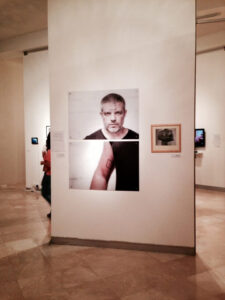
Arik Weiss
Within every local tattoo culture, pieces of history and sociology of primary importance are encoded, alongside anthropological narratives, socio-religious orders, social trends, and deep artistic expressions.
Throughout history, tattoo cultures have undergone changes in meaning, parallel to socio-political changes: sometimes they were given deep and sacred meaning, and sometimes they were used in an oppressive, derogatory, and freedom-robbing way (such as slave tattoos in antiquity or the tattooing of prisoners’ arms in Nazi concentration camps).
It can be discovered that the developments and changes in the status of tattoo culture throughout Western history were parallel to the social and political changes that occurred at that time. In fact, they are their expression. Unlike Western culture, in non-Western cultures (Japan, East Asia, Polynesian islands, Central and South America, and the Arctic), tattooing constitutes a central act within shamanic ritual and a tribal worldview where rites of passage and initiation are an integral part of human existence.
Various cultures around the world carry mythologies, contents, symbols, and archetypes with great similarity (Mircea Eliade) and create universal patterns and symbols (Edmund Carpenter).
In these cultures, tattooing is actually a developmental catalyst. Images and symbols that appeared in tattoos have been studied in the relationship between the private and the collective: in Carl Gustav Jung regarding the “collective unconscious,” and in Noam Chomsky regarding “universal grammar.”
Didier Anzieu’s studies on the consciousness of the “skin-ego” help in understanding the psychological and emotional significance of the act of tattooing, which is shaped in infancy and early childhood as a mirror of the body-mind experience. The initial touch and the quality of the sensory experience between mother and child shape his security and mental health.
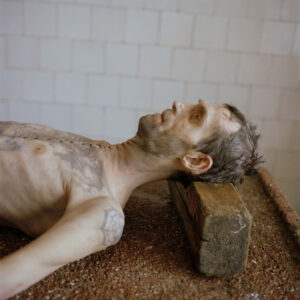
Jenny Barst
The skin is the largest organ in the body and is connected to the nervous system. It functions as the gatekeeper of the body’s boundaries and the distinction between internal and external. The skin has a role of reception and internalization, as well as transmission and emission. A person’s primary sense of identity is solidified by the consciousness of a “skin-ego”—a psychological envelope through which the world is experienced.
In this context, creating a tattoo on the skin is a powerful sensory experience.
“In turning my attention to the skin as a primary datum, at once organic and imagined, a defense mechanism for the individual and at the same time a tool and a primary space of exchange with the other” (Anzieu, in his book “The Skin Ego”).
The act of tattooing manifests psychic materials in a formal way. An abstract idea stemming from the depths of the tattooee’s soul becomes, through the tattoo, a daily, simple presence, and this allows for a purifying observation. Artists and tattooees perform an action that can be compared to “framing.” This is a focused archetype that receives value as a “visual signifier” of an infantile psychic experience.
Undoubtedly, tattoo culture allows for an unconventional look at all areas of life and a re-examination of worldviews.
In conclusion, on a personal note, this exhibition began following an independent research project I conducted, out of curiosity to better understand my beloved profession—the profession of a tattoo artist—and it became a source of inspiration, creation, and endless livelihood for me. Over the years, I developed the method of spiritual guidance through tattoos©. By dedicating my time and energy to learning symbols, archetypes, and the history of global tattoo culture, I have become a more professional, high-quality, and useful tattoo artist for my clients. My curiosity and love for the profession of tattooing led my life into a wonderful adventure of ongoing inquiry and discovery. I am fascinated by this profession and feel fortunate to be part of a special community with a fascinating history that allows one to penetrate the depths of a human soul. A vocation that allows me to help others discover, define, and shape themselves creatively, as a positive transformative lever for them.
My thanks go to all the researchers and the many sources from which I drew for the writing of this research.
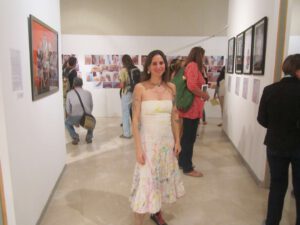
The exhibition Tattoo Representations in Contemporary Art presents a fascinating variety of artworks by artists from Israel and abroad who address the act of tattooing in various ways and reveal the range of internal motives for getting a tattoo within the contexts of defining personal, national, gender, social, cognitive, and spiritual identity.
Yasmine Bergner is a multidisciplinary artist, tattoo artist, and researcher.
To download the full exhibition catalog