
Until recently, the art world ignored the field of tattooing, marginalizing it and labeling it as primitive and inferior,
yet in recent years, more and more artists have been using tattooing as a practice, a symbol, or an artistic act.
Physical Ownership of the Symbol – Article by Yasmine Bergner
Originally published in the online magazine Erev Rav, 2012
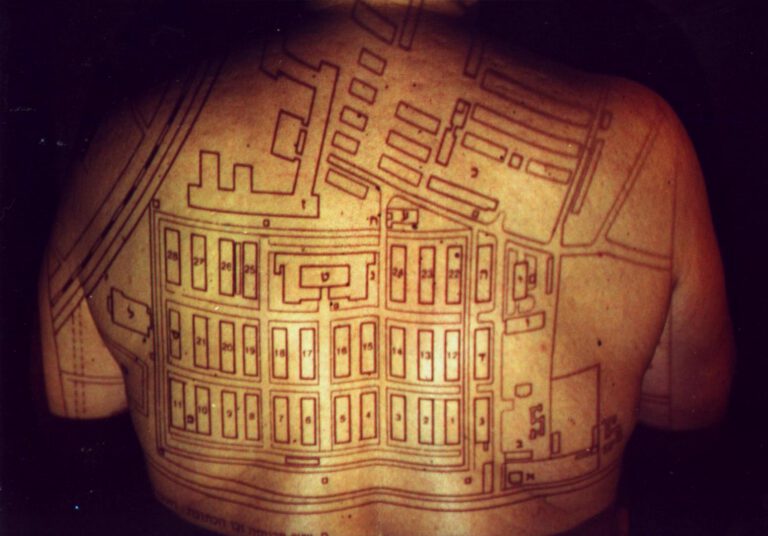
Photograph: Haim Maor, “Map of Auschwitz”, photograph, 2001
Tattoo art today is distinguished as an independent branch within the art world and engages in dialogue with contemporary, classical, and tribal art. It produces intriguing hybrids between “high” and “low” art, contributing to the breakdown of conventional dichotomies and hierarchies. At its core, this is a pluralistic and inquisitive space that seeks to learn from others within a multicultural existence, emerging here almost as a cultural agenda.
Thus, in the realm of tattooing, a traditional design from the past can coexist alongside a contemporary design, as well as with conventions from digital, graphic, comic, or manga design. This article briefly examines the mutual influences between canonical fine art and tattoo art in one specific context: oppression versus social individualism. This is, of course, only one of many aspects that could be discussed in this context.
Until recently, the art world ignored tattooing, marginalizing it as primitive and inferior. In recent years, there has been a clear trend of warmly embracing the genre, with more and more artists using tattoos as practice, symbol, or artistic act. Many cultural researchers have recently pointed to the phenomenon of “renewed fascination,” expressed in a return to mystical, transcendent, spiritual, and even religious elements. According to art historian David Shparber, this trend is expressed in the general art world and also locally, in works based on the creation of private systems of myths and rituals.
As an artist and tattooist, I believe contemporary tattoo art is distinguished by its ability to “create” and redefine personal and collective identity, through historical influences gaining new meaning in the present era. Tattoo art rekindles a connection to mythic ancestors and artistic and historical contexts of the past, while providing a personal and contemporary context to what they represent.
Since the spread of Christianity, tattoo culture was condemned as a pagan relic. In classical times, tattoos were associated with terms such as barbarism, crime, and slavery. Tattoos marked slaves, soldiers, or criminals, as well as shame and regret (according to Hygatius Renatus, 3rd century, and physician Aetius, 6th century, Constantinople). Consequently, tattoos have been stigmatized as acts of social rebellion expressing deviance. Until recently, tattooists in Western society were considered “rebels” who helped others express their uniqueness through conspicuousness. In contrast, in tribal worlds, tattooing is embedded in social conventions and ancient ritual traditions.
In his book “Madness and Civilization,” Michel Foucault extensively discussed how one of the main tools for oppressing the individual and labeling them in society was through asylums. “The asylum is a religious domain without religion, a domain of pure morality, ethical uniformity. It expels everything that could preserve the traces of dissent from ancient times. The last remnants of ritual were suppressed,” he wrote.
In modern times, the topic was notably addressed in the 1908 essay by architect Adolf Loos, “Ornament and Crime,” in which he condemned the urge for ornamentation and exalted functionalism and minimalism. His ideas became a political agenda that prefigured, to some extent, the Nazi aesthetic. Loos found a common denominator between Western society and tribal cultures, arguing that both were, in essence, amoral. His claim was based on what he observed as an unconscious existence shared by every infant and by the elders of tribes in Papua New Guinea. According to him, the “barbaric” customs of a tribal member (murder, tattooing, etc.) cannot be judged by moral standards, as they are like infants. However, Loos considered the modern tattooed person a “degenerate or criminal.” He noted, “Eighty percent of prisoners are tattooed, and those tattooed but not in prison are either potential criminals or degenerate aristocrats.” He continued with his criminological thesis, stating, “A tattooed person who commits suicide dies years before they could commit murder.” More sharply, he wrote, “Cultural evolution is synonymous with the elimination of all ornamentation from everyday objects.”
Psychologist Ernst Jentsch in his 1909 essay on the psychology of the uncanny, followed by Sigmund Freud in 1919, explored the phenomenon of the “uncanny” — the foreign and unconscious that triggers anxiety in human life. To them, frightening and unpleasant content that we do not wish to confront occasionally manifests in real-life encounters, creating a sense of threat. While the literal translation of Unheimliche (the uncanny) is “not familiar,” it can also signify what was meant to remain hidden but came to light, like a revealed secret. Thus, two opposing meanings are fused in the term — the familiar and the repressed. Similarly, tattooing brings repressed, raw content to the surface. Tattoos serve as a daily, surface-level reminder of psychic content, sometimes even the darkest and hardest aspects of life. The most private secrets are embodied on the skin. Symbolically, tattoos act as a “second skin,” sometimes serving as protective armor, a healing act, or as a “veil of suffering,” expressing trauma and pain.
As I noted in my article “Experiencing Pain in a Controlled Way,” tattoo concepts examine and challenge bodily boundaries. A special significance is woven into the conventional terms of “signifier” and “signified” — the tattooed body becomes both signifier and signified; object and subject coexist in unison.
In local artistic contexts, this topic has been notably addressed by Israeli “second-generation” artists regarding the Holocaust. The Nazi regime cynically used tattoos to label (and literally “mark”) individuals as objects. Holocaust tattooing embodies a cruel mechanism for stripping personal identity, rendering the individual cataloged and documented for a merciless mechanical purpose. A strong artistic response appears in the work of Chaim Maor. In his series of performance and sculptural works, Maor addresses Holocaust tattoos, including the number tattooed on his father, and even created a striking portrait showing an Auschwitz map tattooed on the back.
“Dealing with the Holocaust is not about national memory or a historical problem expressed through art. It is a private, personal, familial case expressed in the pursuit of identity, out of necessity, compulsion, internal drive, obsession, therapy, etc. In other words, the personal motive, engagement with personal identity or awareness of the ‘shadow’ or the ‘follower’ attached to one’s back” (Chaim Maor, “The Sabras Who Did Not Walk in the Fields” in: “Hidden Memory / Visible Memory: Holocaust Awareness in Israel,” Ministry of Defense, 1998)
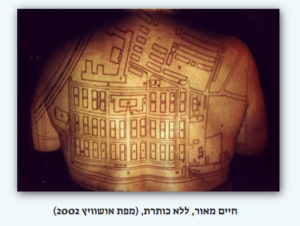
Haim Maor, “Map of Auschwitz”, photograph, 2001
On the other side of the world, yet within a similar cultural context, Chinese artist Qin Ga (b. 1971) tattooed a map of China on his back. During an ongoing personal race, he tattooed the map of China across a span of time and space as a protest against the inhumane treatment and trampling of human rights by the Chinese government toward its citizens.

Qin Ga, “Site 22: Temple of Mao Zedong”, Beijing, 2005
Another artist addressing the oppression of the individual by society is Spanish artist Santiago Sierra (b. 1966). Sierra created video and still photography documenting laborers hired to stand in a line against a wall, backs to the audience. The artist tattooed a continuous line on their backs to illustrate how capitalist society “erases” the individual and exploits them. Again, the back was chosen to highlight the erasure of personal identity.
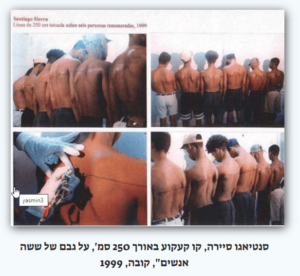
Santiago Sierra, “250 cm Tattooed Line on the Backs of Six People”, Cuba, 1999
In a very famous photograph, American artist Catherine Opie (1961) presents the viewer with a seemingly innocent childlike drawing tattooed on her skin, in fact a colorless “childized” tattoo. The tattoo creates a conflict between the simple, childish symbolism and the harsh, painful presentation. Opie, who works extensively with the LGBTQ+ community, communicates her longing for a partner and building a home with them, evoking childhood trauma memories poignantly.

Catherine Opie, “Self-Portrait”, 1993, chromogenic print, 40 × 3 inches
Thus, one can see a similar approach by several artists operating on different cultural, mental, and physical extremes, addressing various situations of oppression through tattooing. The artists chose the back as a site to imprint the mark of oppression; in all cases, the figure emerges faceless and identity-less, persecuted metaphorically through personal and collective memory.
The social policing of women’s bodies is also explored by Israeli artist Raya Brokental (b. 1975) in the context of kosher dietary laws, which derive from an intrinsic form of internal propriety. Brokental created a video in which a figure wearing a “Miss Piggy” mask tattoos the kosher mark on another woman. The work engages with cultural legitimacy and tradition versus what is condemned, creating paradoxes related to “prohibitions.” The tattooed mark, normally forbidden by Jewish law, paradoxically appears as a kosher symbol. The pig, as the “certifying” figure, becomes a symbol of impurity and degradation in Jewish culture. Here, the tattoo act is invasive and transforms the skin into an ethical and tangible boundary. The mark Piggy tattoos is the American kosher symbol for food, giving it a global dimension akin to pop art, where essential values are distributed through the apparent universality of American culture. Piggy’s pop-art image softens the fact that it is a pig, revealing both the difficulties of being a pig and a woman in the Jewish state, highlighting the notion of “the Other.”

Raya Brokenthal, “Miss Piggy”, Video, 2002
Back to pigs, Belgian artist Wim Delvoye (b. 1965) is known for his controversial and problematic act of tattooing pigs. Delvoye creates simultaneously appealing and repulsive images that provoke antagonism and internal conflict. Rumor has it Delvoye explored how a pig’s economic value could increase by turning it into “art,” raising questions about the economic aspect of art. Delvoye (like Santiago Sierra) uses the economic system to “exploit” and expose its coercion and force. Through this, he produces striking contradictions regarding morality and ethics.
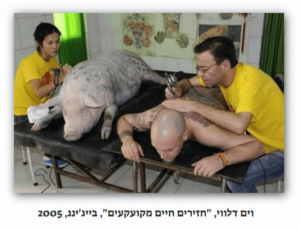
Wim Delvoye, “Tattooed Live Pigs”, Beijing, 2005
Creating a tattoo on the skin is a powerful sensory experience. The skin is the largest sense organ in the body, defining the boundaries between inside and outside. It functions as receptor and absorber, as well as transmitter and emitter. The tattoo act manifests psychic material in tangible form. An abstract idea from the tattooed person’s psyche becomes everyday presence through tattooing, allowing contemplative observation. Artists and tattooists engage in an act akin to framing — a focused archetype of mental experience given value as a “visual signifier.”
As a final contrasting example, artist Anisa Ashkar seeks to empower the individual and highlight their personal identity. She uses her face and body as a canvas, raising questions about social, gender, and national identity. In recent years, she performs a ritual each morning, painting (symbolically tattooing) Arabic calligraphy on her face — a traditional male artistic form born from Islam. In this act, Ashkar highlights the power of the gaze — experiencing individuality and “visibility” to others versus “erasure” and transparency. Ashkar notes, “I was tired of being looked through […] I had a strong physical need to do something on my body […] Freedom is taken by teeth and nails, and it returns you to being an animal.” This is a call for individual, cultural, and feminist freedom, as a woman claiming sovereignty over her fate and transcending oppressive life circumstances. In this sense, tattooing marks uniqueness and acts as liberation.
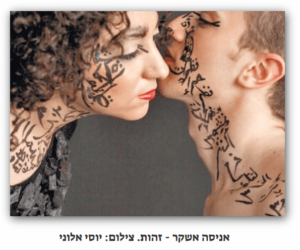
Anisa Ashkar, “Identity”. Photograph by Yossi Aloni
In his book “Black Skin, White Masks,” post-colonialist writer Frantz Fanon addresses the identity and self-image problems of “any people who underwent colonization — that is, any people who developed an inferiority complex due to the erasure of their native culture — facing the language of the colonizing nation.” According to him, “A person who has ownership of language also thereby has ownership of the described world […] Language is ‘the lost God in flesh and blood.’ I feel the depth of this statement in the context of tattooing. The tattooed person, as Fanon noted, takes ownership of the tattooed symbol. Physical ownership of the symbol creates inherent magical ownership over everything related to it. Adopting a language or symbol and inscribing it on flesh creates identity and develops culture in its deepest sense.”
Yasmine Bergner is a multidisciplinary artist, tattooer, Therapist and researcher
Special thanks to David Shperber