


The deep wounds left by the Holocaust and World War II have cemented the swastika in our consciousness as a symbol of satanic evil, racism, and fascism, despite the symbol itself being innocent. Seven decades after the Holocaust, the swastika remains one of the most vilified and despised symbols.
ManWoman, the Canadian artist and poet who passed away last week,
Reclaiming the Swastika – by Yasmine Bergner
Originally published in the online magazine Erev Rav, 24/12/2012

ManWoman, a Canadian artist and poet who passed away last week, dedicated his life to reclaiming the swastika. Since the 1960s, he worked to take the symbol back from evil, following a series of dreams that called him to undertake this mission. He tattooed approximately 200 swastikas on his body, all representing “Let there be good” in Sanskrit, and authored a book titled Gentle Swastika: Reclaiming the Innocence. He is considered the spiritual father of the Reclaim the Swastika movement, which seeks to restore the symbol’s original, innocent meaning. His unique name was given to him by entities he saw in dreams, and in 1971 he made it his official name.
In his book “Gentle Swastika”, ManWoman describes the circumstances that led him to this mission:
“In the year before this, I experienced inner events in which I was swept into a swirling energy, into what I could only call the ‘Womb of the Sacred’ — an image of a vortex that recurred in my later dreams in 1967, eventually taking the shape of a white swastika. In these dreams, I saw the figure of an old wise man marking a white swastika on my throat, telling me to take on the mission ‘to redeem the symbol so that it touches the hearts of those who behold it with love.'”
“My mother immigrated from Poland, and her sister and son were sent to Auschwitz. I grew up in the presence of the intense emotions of Jews against the swastika and the trauma left by the Holocaust and World War II. It is no surprise that I felt apprehensive about the challenge before me. Yet the dreams continued — dreams of small children playing with jump ropes decorated with tiny swastikas; waitresses in cafes wearing dresses covered in swastika patterns; and strange animals shaped like swastikas. And in all of this was such a playful feeling.”
ManWoman told Vice magazine that his mother thought he was having a nervous breakdown, and his close friends whispered behind his back. He explained to them that the swastika is a sacred symbol. One friend showed him a Native American beadwork with a swastika from North America. Another friend showed him a photo of a women’s hockey team in Edmonton with the swastika printed on their uniforms. His grandmother had been a member of that team.
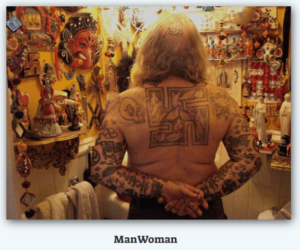
This marked the beginning of ManWoman collecting artworks, photographs, and historical pieces of various swastikas from around the world to document the symbol’s presence globally, independent of Nazism, and he established the Swastika Museum in his hometown in Canada. He emphasized the innocence and joy associated with the swastika before the rise of Nazism.
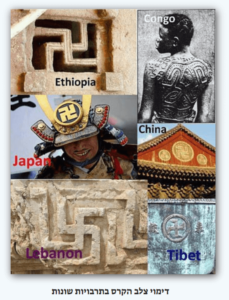
Historians agree that the oldest origins of the swastika trace back to Mesopotamia and the Indus Valley (around 3000 BCE). From the Upper Paleolithic period — in Buddhism, Hinduism, Christianity, Native American traditions, Africa, Islam, and even in Judaism — swastikas appear as part of ethnographic symbolism. An ancient synagogue mosaic in the Golan Heights shows swastikas. Buddhist examples integrate the swastika within a Star of David as part of prayer; there is also a geometric and formal similarity between the swastika and the Star of David.
The swastika visually represents creation in all its forms, evolving from the image of a cross within a circle, symbolizing the sun’s path in relation to the heavens (the zodiac). The four directions represent the four winds of the sky and the four equinox points in the year.
Thus, long before World War II, the swastika was a sacred universal symbol of power and blessing, visually representing the “spin” of the universe. Spin is a fundamental principle in unified field physics and sacred geometry, demonstrating how all natural phenomena rotate — from sound waves to the DNA helix to celestial movements. In other words, this ancient graphic is a 3D representation. The principle of spin illustrates movement in space — just as sound waves spiral.
In an interview, ManWoman explained why the tattoos were essential: “It started with a small swastika tattoo on my pinky. Later, in 1970, I dreamed that Hitler himself stole the swastika from me, so I felt compelled to tattoo swastikas on my arms to reclaim them. Then came visions of the third eye, awakening in a mystical experience, which I tattooed on my forehead. My wife was shocked, and that ended our marriage. Many called me ‘obsessive,’ but for me it was a positive obsession.” Eventually, he tattooed about 200 swastikas on his arms, chest, and back, designing a swastika with doves inside: “I wanted to create a special swastika that even my Jewish friends would appreciate.”
ManWoman often faced confrontations regarding his swastika tattoos from people who assumed he was a neo-Nazi. In such situations, he explained the true history of the symbol and his mission. Generally, this helped open hearts. In recent years, awareness of the symbol and its true essence has grown, and instead of negative reactions, ManWoman received hundreds of appreciative and supportive messages.

At age 74, ManWoman stopped tattooing. For him, the tattoos always served a very specific purpose, inspired by his dreams: “I no longer have such dreams. I dream differently now, so continuing would be pointless. It was truly magical, and I received support from… you could call it ‘Spirit’ or internal forces beyond our knowledge. I am happy to have walked this path, as so many joined me in collaboration, filling my life with excitement.”
For Israeli readers, this may seem absurd, even offensive. Yet, one cannot help but admire ManWoman’s work and his sincere attempts to purify the symbol, innocent of any wrongdoing, because no symbol has inherent meaning except what we give it.
Sources:
Original article in English in VICE magazine.
Translation and additions: Yasmine Bergner, multidisciplinary artist, spiritual guide through tattoos, and researcher.