



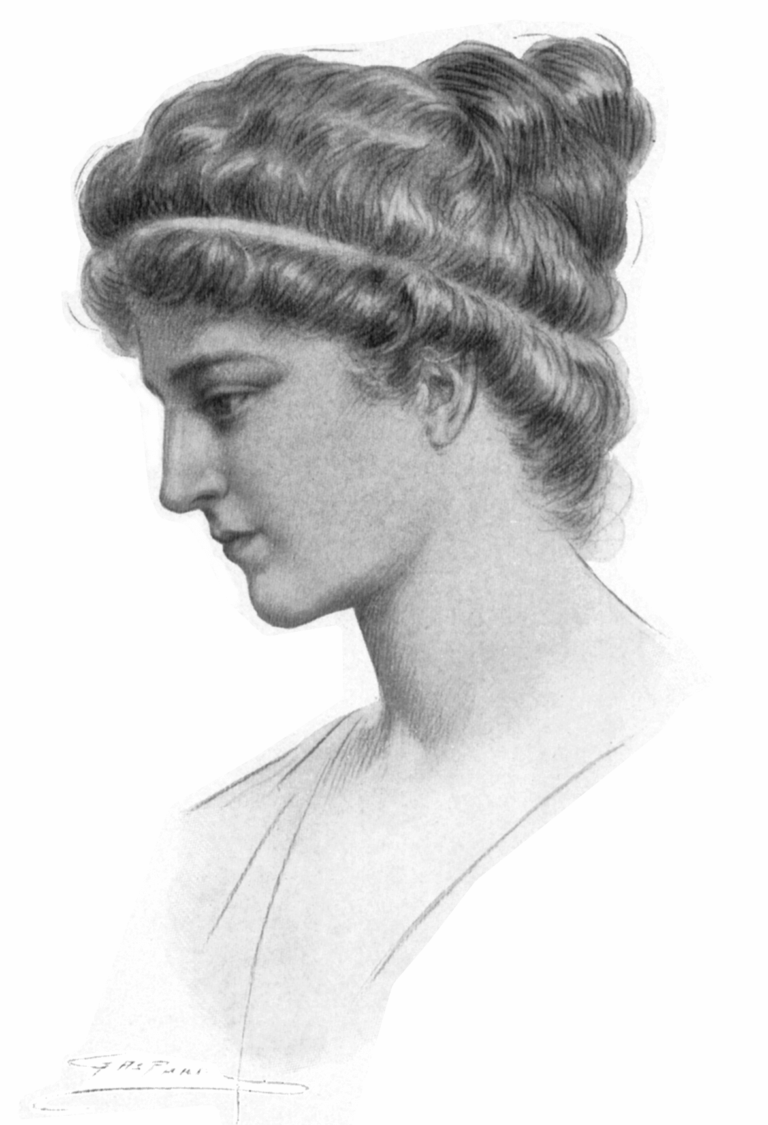
In the spring of 415 AD, a pagan noblewoman stepped out of the lecture hall connected to the Great Library of Alexandria and called for her carriage to take her home. Many educated pagan women enjoyed high social and academic status at that time, but Hypatia was one of the few who traveled independently in a carriage that belonged to them.
Part One: Rejection of the Goddess and the Death of Paganism – The Murder of Hypatia
In the spring of 415 AD, a pagan noblewoman stepped out of the lecture hall connected to the Great Library of Alexandria and called for her carriage to take her home. Many educated pagan women enjoyed high social and academic status at that time, but Hypatia was one of the few who traveled independently in a carriage that belonged to them. She often parked her horse-drawn carriage in the heart of the city to chat with the locals or to engage in lively conversation about philosophy with anyone who wished to speak with her. Her openness and elegant pleasantness brought her appreciation and love from the city’s inhabitants.
Hypatia was officially active in city affairs, an arena dominated mainly by men. It was said of her that her self-control and pleasant manners, which were the result of inner work and years of mental refinement, helped her express her voice with restraint and composure in countless governmental assemblies in which she participated. This ability brought her efficiency and precision in achieving her educational and social goals, and earned her admiration and respect wherever she went.
Hypatia’s beauty was considered legendary, and it was said to be matched only by her intelligence. Tall and confident, commanding her carriage with ease, dressed in the long robe and scarf of the educator class, she must have been an unusual sight in the vibrant streets of the cosmopolitan city of Alexandria. Unfortunately, no realistic portrait of her has survived.
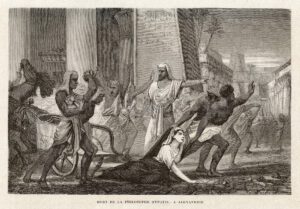
In March 415, Hypatia entered a public square near the Church of Caesar, where Christian converts would gather, and found her path blocked by an angry mob. The mob was led by a man named Peter “the Reader,” and he incited the crowd on that fateful day to close in on Hypatia and block her way. A Christian convert who admired Cyril (a Christian bishop living in Alexandria) said of Peter “the Reader” that he was “a man who believed with all his heart in Jesus Christ.” At the same time, a local governor sued one of Cyril’s protégés who had publicly attacked pagan doctrines. Hypatia supported his lawsuit, and the attacker was severely reprimanded. Bishop Cyril held a grudge against Hypatia for her stance but could not afford to look bad and attack her directly. Long after the day of the horrific murder, the people of Alexandria wondered if Peter “the Reader” had been sent by his master Cyril or had acted independently, hoping to gain the patriarch’s trust.
Public opinion was that Bishop Cyril conspired to murder Hypatia because, on various occasions, he had publicly accused her of witchcraft. Peter incited the mob to throw heavy tiles at Hypatia and knock her off her carriage. Her robes and long scarf created an advantage for the angry mob, and they quickly overwhelmed her by pulling hard on her light, long clothes from all sides. Hypatia fought with all her might to escape, but in vain. Throngs of arms grabbed her forcefully and began stripping her of her clothes. A local crowd gathered at the edges of the commotion, paralyzed and helpless, gripped by horror at the bloodshed occurring before their eyes.
The violence of the angry mob escalated thanks to the cheers of Peter “the Reader,” who called Hypatia a horrific heretic—a witch who misleads people through her beauty and teachings, which are nothing but blasphemy by the Devil. Hypatia protested and called for help, but a sharp blow aimed at her jaw prevented her from speaking. Within a few minutes, while on her knees in a pool of her own blood, Hypatia was beaten to death by cruel blows and kicks. The mob was not satisfied with her brutal killing and continued to abuse her body until nothing remained but her bones. The situation was so terrible that none of the witnesses were able to intervene for fear of the madness of the attackers’ violence. The angry cries of the mob of Christian converts turned into cheers of victory and praise for the murder they had just committed. A foreign and inhumane force took over them and created an electricity of unrestrained violence in the air. The killers took the bones to a place called Cinaron and burned her bones to ashes.
Hypatia was the daughter of the mathematician Theon of Alexandria, the last known teacher of the traditions of the Mystery Schools—the spiritual universities of antiquity. Hypatia was born around 370 AD, making her 45 years old at her death.
Historians consider her death to be “**the** event” that defined the end of the classical culture of Eastern-Mediterranean Europe. This traumatic event marked the extinction of Paganism and the rise of the Middle Ages. (Paganism – is the generic name given to pantheistic beliefs, polytheistic with multiple gods and goddesses and nature worship).
Theon was the director of the Museum of the city of Alexandria in Egypt, the place dedicated to the Muses, the daughters of the goddess of memory, Mnemosyne. Each of the Muses embodied a sacred art such as astronomy, poetry, and history. The nine daughters of the goddess of memory presented a model of study and research in the ancient Mystery Schools.
In the year 400, when she was about 30 years old, Hypatia was appointed chair of the mathematics department at the university. She earned a salary equivalent to a professorship at a modern university. Theon’s daughter was also known for her perfect command of Platonic philosophy and the practice of spiritual work called Theurgy, which was a type of magical work that can be compared to Jungian active imagination work and the active imagination practices of Dzogchen and Tantra. Her dialectical abilities were extraordinary and refined through her mathematical training. It was said of her that in philosophical discussions regarding spirituality and the sublime, Hypatia could handle any position in the Christian doctrine in northern Egypt. Her theological abilities characterized the pagan intellectual class (the Gnostics – those who “know” – who understand spiritual matters), but she also specialized in geometry, physics, and astronomy. Ancient learning was multidisciplinary and eclectic, a stark contrast to the contemporary era in the West, where there is a tendency to professionalize and specialize in one usually narrow field. The word “philosophy” means love of wisdom. For the Gnostics, “Sophia” was a revered celestial being, the goddess whose story they explained in their sacred cosmology writings. For the people of that time, Hypatia was wisdom personified.
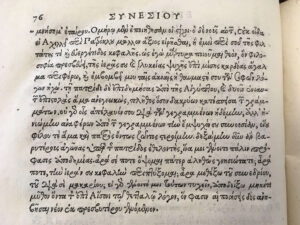
In addition to their spiritual role, the Mystery Schools provided a framework for multidisciplinary education. The Gnostics were exceptionally talented, polymaths, and prolific writers. Between 600 BC and Hypatia’s time, the Gnostics composed thousands of scrolls and writings stored in the Great Library of Alexandria and other libraries such as Nag Hammadi (both in Egypt) that were connected to learning centers throughout the Middle Eastern basin. Hypatia wrote treatises and articles on arithmetic and astronomy, none of which have survived to the best of our knowledge. However, there are 8 historical sources documenting the circumstances of her death and her achievements (the latter not always in a complimentary tone). Bishop Cyril, who was suspected of conspiring to murder Hypatia, was later known as one of the leaders of the theology of the Holy Trinity, along with other Christian ideologues whose fundamentalist faith celebrated the victory of the Church over “heretics” like Hypatia.
Part Two: Between the Birth of Patriarchy and the Rejection of Nature to the Emergence of a New Myth – Gaia Theory
The arts in prehistory—Buddhist, Tantric, Egyptian, and Greek, and everything called “pagan”—were a direct continuation of the pulsing forces of nature. In Western culture, our ability to see the sublime in nature alone has been damaged. Joseph Campbell says this is a result of the rise of monotheistic religions. In the Book of Kings and Samuel, the Hebrew kings “offered sacrifices on the mountains and did evil in the eyes of Yahweh.”
What is the meaning of this sentence and how can it be interpreted critically? In fact, the worship of Yahweh was a certain movement in the Hebrew community, a movement that eventually gained the upper hand. It was the promotion of a specific god limited to his temple, against the nature worship that existed throughout the land. Mythologist Joseph Campbell says that the three major Western religions—Judaism, Islam, and Christianity—call the same biblical God by different names but fail to live side by side. They are stuck with their image without understanding what it refers to. Their myth and cultural ethos are a closed circle that fails to open and perpetuates violence against each other. Every mythology grows in a certain society and is bounded by its geographical area, and then the mythologies clash, manage relationships, merge, and create a larger narrative. There are two completely different orders of mythologies.
According to Joseph Campbell: there is Universal Mythology which builds the relationship between you and your nature and the natural world of which you are a part, and there is Social Mythology which binds you to a specific society. Social mythology is usually of nomadic peoples moving from place to place, so you learn that your center is there, in that group. Natural mythology belongs to agricultural peoples. The biblical tradition has a social orientation that denounces nature and tries to control it. Religions of nature do not try to control but to reach harmony with nature. When nature is perceived as something evil, you do not strive to achieve harmony with it. You control it, or at least try, hence the tension, anxiety, deforestation, imperialism, and the destruction of indigenous peoples. “In the Bible, eternity retreats, nature is corrupt, nature was expelled from Eden. In biblical thinking, we live in exile.”
According to Campbell, humanity needs myths that will not identify the individual with his local group, but with Gaia, our planet. Today there are no longer borders; the only mythology that has sustainable validity is the mythology of the planet. A mythology that will tell the narrative of the formation and true identity of our planet. In Buddhism, there are stories close to planetary mythology, as well as in Egyptian mythology and the Gnostic writings that grew out of it. Gnostic writings connect with what evolutionary biology and Gaia theory teach us, which treats the Earth as an ecological system that has a history of self-regulation and can be seen as a holistic intelligent entity where everything on it is its body. When we put race, culture, and gender before our humanity, we prevent ourselves from deeply knowing what is called “Anthropos”—our true identity as a human species and the future of our covenant with the planet Gaia.
According to Campbell, myth fulfills 4 roles: The first is the *Mystical role*—to remind us how wonderful the universe is and how wonderful we are and the awe before the great mystery. If we see mystery in everything—then everything becomes a sacred image. The second role is the *Cosmological role*—which connects science and spirituality; in this context, sacred geometry is the archetypal symbolic language of the shape of the universe, but in a way that shows us the mystery. The third role is the *Sociological role*—supporting and explaining the existing social order, and here vast differences between one place and another enter. For example, an entire mythology that supports polygamy versus a mythology that supports monogamy. Both mythologies are place and time dependent.
In our Western culture, the sociological role of myth has taken over our world. The fourth role of myth, and it is the role (which in Campbell’s opinion) we all need to learn to relate to—is the *Pedagogical role*—how to live a human life in any circumstances, a connection of universal myth and ethos. And there are many myths that can teach a person to do this. We must re-attain harmony with the wisdom of nature and realize again our brotherhood with all kingdoms. The myth of the future that will grow here will talk about Gaia, the Earth, and everything on it. And it will have to deal with everything the myths before it had to deal with—the maturation of the individual, from dependency to maturity and then departure from the physical world. What will be the relationship of such a society to the world, to nature, and to the cosmos? It will be the myth of human society as a whole.
Joseph Campbell says that in the biblical tradition, which is the basis for the three major monotheistic religions, material life is impure and every impulse is a sin. Unless circumcised or baptized. It was the serpent that brought sin into the world and the woman who brought the apple to the man. Identifying the woman with sin, and therefore, identifying life with sin, is the way the entire story was distorted in the biblical myth and the doctrine of the expulsion from Eden.
The historical explanation according to Campbell is based on the conquest of Canaan by the Hebrews and the subjugation of the Canaanite peoples. “The main deity of the Canaanite peoples was the Goddess, and the serpent is associated with the Goddess. This is a symbol of the mystery of life. The group that promoted a male god rejected it. In other words, in the story of Eden, a historical rejection of the Mother Goddess is implied.”
The Hebrew language constantly forces us to make an effort and choose repeatedly whether to use male or female language, in a way that can always exclude or diminish one of the genders. The default in the language is to use male language as the norm, which repeatedly illustrates the patriarchy within the language. The reference to “God” is always in the masculine, and as much as we are reminded that He is neither male nor female, according to the rules of grammar—the image that comes to all of us is of a male god.
The story also does a great injustice to women because Eve is cast as the one responsible for the expulsion from Eden. Women represent life; the man cannot enter the world of life except through a woman, so the woman is the one who brings us into this world of pairs of opposites and suffering. In the biblical perception, sin begins with the exit from the mythological dream-time zone of Eden, where there is no time, where men and women do not even know they are different from each other, and then they eat the apple and wake up to the world of duality and opposites. In the monotheistic perception, God is “the Father,” but in religions where the God or Creator is a Mother, the whole world is her body; there is no other place.
Part Three: So what is happening with men? The missing link to understanding misogyny
*Selected excerpts from Bethany Webster’s article (the full article is here on the site)
Many of us, women and men alike, are beginning to perceive the breadth of this reality of rampant misogyny. A brave wave of women in recent years has been uncovering records of sexual harassment through the #metoo movement. As a culture, the question is asked: Why does the urge to disparage, hate, and harm women exist in so many men? Where does this reality come from? And what can we do to stop it?
The development of boys and men in the modern world places them in a privileged position, beneath which un-processed rage is hidden under the surface. What is the inner work that men and women can do in order to change the situation? Patriarchy constitutes the principle of dominance, and it can be embodied by both a man and a woman. The role of the patriarch in the boy’s life can be manifested through the mother as well as the father.
The Oxford Dictionary defines misogyny as: “dislike of, contempt for, or ingrained prejudice against women.”
Bethany Webster says that in order to understand misogyny, we must investigate the first relationship a man ever had with a woman—with his mother.
“The relationship of mother and child is revealed as the first relationship damaged by patriarchy” – Adrienne Rich.
“Patriarchy demands of men that they become and remain emotional cripples. Because it is a system that prevents full access to free will, it is very difficult for any person of any class to take a rebellious stance toward patriarchy, to be unfaithful to the patriarchal parent, whether it be a father or a mother” – bell hooks.
A boy maturing into the modern world today undergoes socialization by his father, by other men, and by society, regarding the meaning of being a man. Media culture, education, and patriarchal religion perform the same role. Unfortunately, there is much evidence that the boy’s socialization process largely includes internalizing control over others, repression of emotions, and the devaluation of women. This situation creates personal and collective trauma for the entire human species and the planet as a whole.
Healing personal trauma is central to undoing patriarchy. Unlike the modern world, the history of civilization is full of examples of cultures that give boys the initiation experience of maturing into adult masculinity through periods of physical challenges, helping them symbolically cross a psychological bridge from the relative comfort zone of childhood to the challenges of adulthood.
These boys are assisted by ELDERS (adult men) who provide them with empowerment and positive context. In this rite of passage and initiation, an emotional or physical “wound” occurs that helps the boy come into contact with his inner powers, his self-confidence, and his sense of personal responsibility. Today in the modern world, most boys experience the “wounding” without the positive transformation. There are very few authentic rites of passage and initiation, very few elders (ELDERS), and very few male role models beyond the toxic status quo.
The social expectation to devalue women, and in this context also their mothers, creates cognitive dissonance in the boy regarding his mother’s meaning to him, which is destructive to his ability to express emotions, allow himself to be vulnerable, express physical affection, and more. In this way, the mother is usually experienced as a “lost source” for the boy. And the father, as the socializer of the boy into the world of men, is experienced as the one who breaks the alliance with the mother, with the source.
“The core of men’s fear of feminism is the fear that by becoming complete human beings, women will cease to be mothers for men, to provide the nourishment, the lullaby, the continuous attention associated with the mother-infant relationship. Much of male fear of feminism is actually infantilism—the longing to remain the mother’s infant son, to completely take over a woman for his own needs. These infantile needs of adult men toward women have received sentimental and overly forgiving romantic treatment until now as ‘love.’ This is the threshold of violence. Because the social order, the economy, and the legal system have leaned heavily in favor of men, the infantile needs of the adult male received validation by the mechanisms of power—those same mechanisms that do not give the same validity and approval to the needs of the adult woman. The institution of marriage and motherhood perpetuates the needs of the infant male as law in the adult world.”
Researcher and therapist Tamir Ashman says that the prison system is the capital city of patriarchal culture, a place where wounding masculinity merges with wounded masculinity.
What is happening now thanks to the #metoo movement, when women tell their experiences of sexual assault and bring their abusers to light, is that the total control of men over women in the domestic space and the workspace is decreasing. Now women are less and less willing to remain a silent slate upon which men project their un-processed pain and remain unpunished. Additionally, many male witnesses are no longer willing to look the other way.
It seems that the inner child in the man is unconsciously trapped between his painful longing for the “lost source” represented by his mother and his social conditioning to hate her as a woman. In other words, men are trapped between the natural desire for their full humanity (the ability to be emotional, vulnerable, and empathetic) and their desire to remain in a state of privilege and dominance. The point is that you cannot be both. To hold onto a position of dominance (patriarchy) means gradually losing your humanity. The meaning of being a real human being means giving up your desire for control and all the horrific ways it is manifested. No amount of privilege (wealth, power, fame, and status) can ever compensate for the destruction that patriarchy wreaks on the child within. No amount of power over others can compensate for the loss of that part within him. Only through inner work can one reclaim ownership of the loss of this inner essence.
A man can find this “lost source” not within a tangible woman but in the form of inner inquiry, through the attempt to understand what the *mother* or the feminine represents within himself. For example, the meaning of emotional functioning, the world of feeling, the experience of deep connection with himself, and the sense of authentic belonging to those around him. However, in order to create a connection with these vital qualities found in the darkness, the man must create a connection with the inner child angry at the meager profit he received in exchange for abandoning the vital aspects of his selfhood.
It is easy to project rage onto a “mother substitute” or “father substitute” somewhere in the world. Male privilege allows a man blindness toward the mother and father wound while the world is on fire.
It takes courage to reconstruct these projections and process the rage at the inner patriarch—the archetype of the cruel, emotionless father who welcomed him into the world of men at the heavy price of disconnection from his authentic self. The innocent child who came into the world with a built-in ability to express empathy, emotion, and vulnerability. The rage belongs to the patriarchal father (personal or collective), the alliance-cutter who betrayed the boy, who brought him into the brotherhood of men at the price of amputating a vital part of himself in order to be accepted in the world as a man. The rage also belongs to the mother who was unable to protect him from the patriarchal wound, or who caused it herself. When men manage to direct their rage there, to the place where the rage truly belongs, then things can begin to change.
“Misogyny is the outward-projected rage of the son at the mother who could not protect him” – Gabor Maté.
“When we understand that patriarchy is a social invention, an invention intended to compensate for helplessness, we understand that men, contrary to popular opinion, are actually the more dependent sex.”
Webster says it is not the man’s fault that he is so vulnerable, so dependent, that he is simply human (and in Part 2 we stood on the deep sources of man’s dependency on woman, which is the only way for him to “enter life”). But his responsibility is to identify how much every child needs positive parenting and how much the pattern of this need affects his soul life and continues to operate beneath the surface. He may pretend to be an empowered man, holding the reins of government or the wallet, but the cracks of tension seep through and reach deep into his relationship with his mother. Men must understand this fact and take responsibility for it; otherwise, they will continue to enact these infantile patterns forever.”
Healing the *mother wound* for men involves shifting the projected rage away from women and processing it directly against its true object—patriarchy itself—and against the specific traumatic events that occurred in their childhood.
In order for men to succeed in doing this deep inner work, they critically need support from other men who have already undergone a significant part of this process and inner journey, and this also includes professional support from male therapists experienced in this field.
To define it broadly, inner and outer work for men includes:
- Processing the rage toward the parent (father or mother) for the parental betrayal that forced him to give up vital parts of his selfhood in order to be considered a man in the world. Mourning the heavy price this took from him.
- Looking honestly at his life, acknowledging the secrets kept within him, and taking responsibility for his actions.
- Finding his lost inner source and working to reclaim ownership of it. Connecting with the inner child.
- Connecting to sincere feelings of remorse for the way he harmed other human beings and the planet itself through the externalization of his pain in unconscious ways, personally and collectively, and initiating empathetic actions on a regular basis.
- Creating a community together with other conscious men who are on the path of recovery and reconciliation.
Men must devote themselves to long-term inner work, and it is also essential that they immediately experience the consequences and results of their actions here and now.
Until men gain enough inner integrity to restrain them from sexual assault and acting with physical violence—the results of which we see increasing in the world and in our country—real intervention actions are required in legislation, police and judicial enforcement, and in protecting women in the workplace and within their family relationships, which will bring toxic behavior to a halt.
In principle, men themselves require global intervention. A resounding social “no” calling for an awakening and recognition of realities they were blind to until now.
In order to support this process, we as women must say “no” in every possible way to the angry boys inside the men in our lives. Whether they are friends, colleagues, brothers, or husbands. Women are required to withdraw from the ways in which they act in “over-functioning” or act as mothers of the men in their lives.
“We must withdraw with the breast, with the lullaby, with the incessant attention associated with the mother-infant relationship.” In this way, men will be able to feel the weight of the difficult situation, and this is the first stage on the path to significant and sustainable change.
Only when men feel the painful gap of what women are no longer willing to endure for them will a sufficient experience of motivation awaken in them that will finally help them act and complete the gap from within themselves.
The process will gradually open paths of:
* Taking responsibility for their feelings, containing and processing them within, and obtaining support.
* Having sex out of a desire for intimate connection, and not as a means to feel powerful.
* Comforting the inner child when it is triggered.
* Distinguishing between past pain and what is happening in the present.
* Developing awareness regarding the consequences of actions and the ability to see the women in their lives as human beings and not as objects.
* Centering and empowering marginalized voices, developing the ability to listen and learn from them.
As women, we must continue to use our voices and speak about inappropriate use of power at every opportunity we have and empower the voices of other women suffering from male abuse, especially among minorities and indigenous cultures.
As women, we must cease:
* Collaborating with male illusions stemming from ignorance regarding their over-entitlement.
* Remaining silent and avoiding friction.
* Internalizing within ourselves the consequences of un-processed male rage.
* Minimizing our feelings in their presence.
* Accepting crumbs of respect instead of what we truly deserve.
* Giving our power and strength in the form of a therapeutic relationship.
* Giving time and energy to men who refuse to do the inner work.
The truth is that women are very limited in their ability to assist men in their healing. We can hold space for them, but we cannot do the work for them. This is their journey and they must want it. Meanwhile, let us expand the consciousness of our self-worth away from the male gaze, prioritize our inner work, and heal our childhood wounds. Let us maintain clear boundaries with the people in our lives who are not doing inner work and spend more time with those who are. True sisterhood is a crucial source of nourishment at this time.
Harnessing our rage as fuel for wise action
The more we connect to the truth of our power as women—the more we will feel rage at the destruction and devastation caused by toxic masculinity. Rage is an essential tool at this time, in order to sharpen the refusal to fall in line with oppression of any kind, including internalized misogyny directed at ourselves, and for white women—it is a refusal to play the role of the patriarch toward others and to look straight at the way we mediate oppression of men and women in ethnic groups other than our own.
“We oppress what we fear.” – James Hollis
Recovery from patriarchy requires that every group enjoying over-entitlement confront its ignorance and develop sincere empathy regarding how its privilege caused harm to others.
May there come, following this mounting tide of female rage, a surge of brave men ready to explore their inner space, to embrace the abandoned child within them, to process the legitimate rage, and to mourn what patriarchy stole from them: their full humanity. Collective change will occur when enough individual men change. May men take full responsibility and humbly embrace the exposed discomfort—as the medicine they need in order to heal their personal and collective *mother wound*. And may women refuse to allow the behavior of unconscious men to define them.
Sources:
Bethany Webster – The Mother Wound as the Missing Link to Understanding Misogyny, Article
[https://womboflight.com/article-169257](https://womboflight.com/article-169257)