




Yasmine Bergner | Solo Exhibition
Artness Gallery | Center for Contemporary Dance | Kibbutz Ein Shemer
2011
Embodiment of mind
On Physical Internalization in the Works of Yasmine Bergner
Yasmine Bergner’s works converge into the space of the unconscious and into archetypal symbols through physical presence. The process takes shape through authentic movement in space (metaphorical and actual), and at the end of each “movement,” there is a connection to the conscious recognition of the symbols that have accumulated there.
She flutters like a butterfly between different mediums: photography (which is essentially a documentation of performance), painting, drawing, and sculpture. Nevertheless, one can notice that in all of them, there is an affinity for the same continuous engagement with representations of psychological experience through the body. The figures in the performance photographs speak through their bodies—the mental space they inhabit. Psychological and cultural depths are revealed, which in a certain sense are usually far from the eye. Entrails are exposed and explored in a manner that is both intuitive and distinct, analytical and blunt.
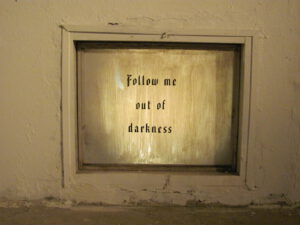
In this sense, it can be said that Yasmine Bergner touches upon taboos. She touches exposed nerves, the experience of pain, the desire to bring things “into the light”… through the skin… in order to bring to the surface, to consciousness—states of being beyond words.
Photographs: A collaboration between Yasmine Bergner and photographer Jude Moscovitz
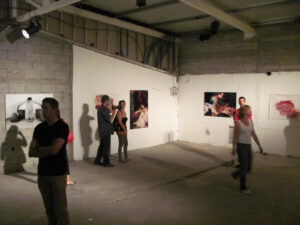
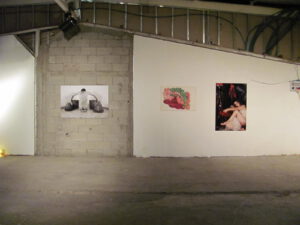
Embodiment of mind
In his artistic work as a creator and dancer using tools of improvisation, Shahar Dor connects his students to the intuitive experience embodied in spontaneous movement in space. An attempt to reach a movement that does not “describe” but “is” the thing itself. This is a state where there is no use of the analysis of the “mind” but rather a pure internalization of the “mind” and its embodiment in movement. Within this “empty” space, a spontaneous space is created, a “fertile emptiness,” which allows for the continuous creation of new movements in space to infinity. In authentic movement, there is a meditative self-forgetfulness, which can only understand itself at the end of a movement process. But only in retrospect.
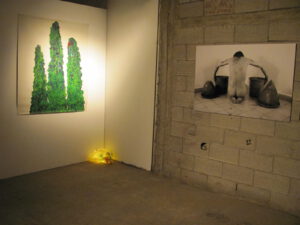
Thus, in Yasmine Bergner’s works, there is a physical embodiment of a metaphysical vision (or dream). She creates “spontaneous sculptures” from fresh clay which, at the end of the performance, are stripped of their form and returned to the bucket. Like in the biblical phrase “From dust you came and to dust you shall return“… the infinite wheel of life and death is embodied in the performative action. The clay is the dust, the base of creation. The works attempt to point to what is not eternal—versus what is timeless.
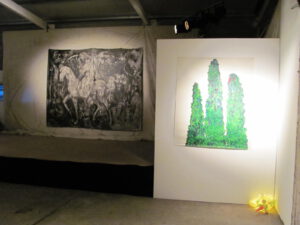
In the paintings, there is a dance of stains and colors building into a detailed abstraction. The paintings can be seen as abstract painting or a type of landscape, and they can also be read as internal organs, sculptures existing in space. Abstract objects whose “three-dimensionality” is intensified following the dialogue with the “empty space” in the painting. In the drawings, as in the paintings, there is an intensity and meditative focus as if every pencil line and color stain undergoes a process of “mitosis”—the infinite division of a cell. Hovering over all the works is the presence of the “eye”—the observation of the exposed tissue.
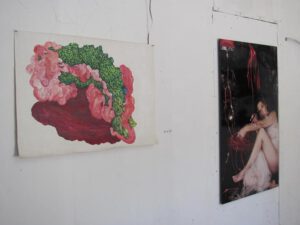
The restless observation and the touching of the “wound,” the taboo, which exists in all the works in various forms, in our sensory organs, leads to a process of internalization and, following it, to transformation and change. Which is the thing we all try to reach. In the photographs, through the performative act, Yasmine touches the metaphysical—the nameless experience, through the language of the theatrical “gesture,” the performance.
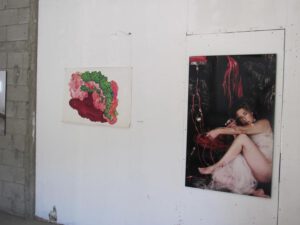
The photographs can be read in relation to what they are not. They are not photography in the usual sense; their aesthetic value stems from being a documentation of performance, the situation occurring within them and not just because of the way they are presented. This is a performance—with the consciousness of a plastic artist, where sculptures and paintings take part as props within the photographic space.
(In this context, one can mention “ancestors / contemporary fathers and mothers” who exist in the same tradition of artistic engagement, such as: Rebecca Horn, Matthew Barney, Vito Acconci, Bruce Nauman, and Ana Mendieta, and of course the ‘forefather’ Joseph Beuys. All are artists whose work exists at the intersection of performance and plastic art, who deeply influenced the artist).

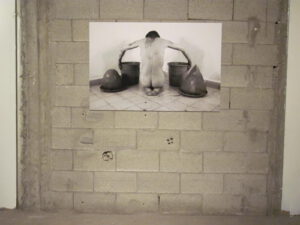
The photographs maintain layers upon layers within them, meanings and anecdotes taken from ancient classical cultures, from multi-culture, and down to personal meanings, thus creating a dialogue with the personal “mythology” existing in every individual and the view of the person as a holistic unit composed of a multiplicity of personalities hidden within the soul. For example, in the black-and-white photograph “Buckets,” there is a deceptive identity where at first glance it is unclear whether it is a man or a woman.
The tribal Shaman connects the personal to the universal. Similarly, in Bergner’s performance works, personal symbols leak into a collective consciousness. Just as shamanism serves as a mediating action between the physical and the metaphysical, so in the works, physical internalization serves as a containing vessel similar to the Mother, an unconscious intention of the mind and the collective super-conscious.
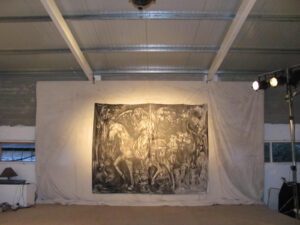
The works succeed in conveying a stable and contained “bluntness,” in a softened but unapologetic way. The chaos and darkness in the work “Death on a Horse” (tribute to Dürer) is self-aware and possesses self-humor, until it succeeds in ridiculing death in a punk-like move. In other words, despite the “dark” present in the works, it is important to emphasize that there is a perception of the artist as a Shaman and art as a process of alchemy, transformation, and healing, from a place of deep belief in a higher power, recognizing that there is dark matter in the universe, beyond our understanding.
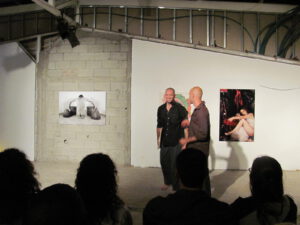
Shahar Dor and Yasmine Bergner
May 2011
Performance by Shahar Dor
Kultura Festival Ein Shemer Opening Night
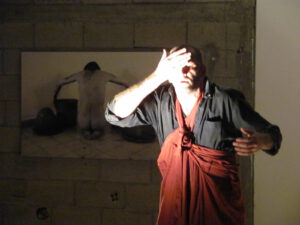
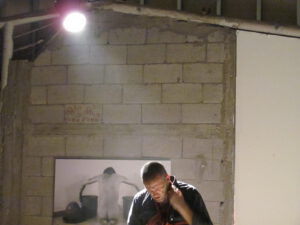
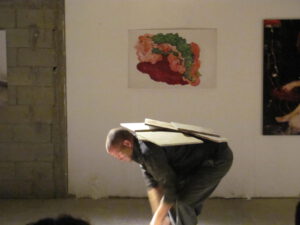

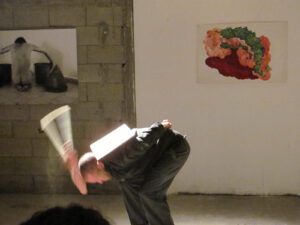

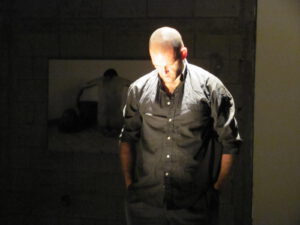
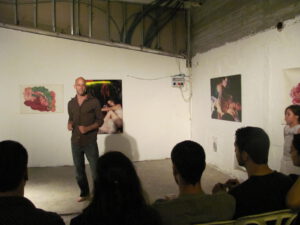
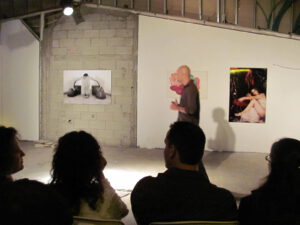
A Matter of Light | Solo Exhibition for Yasmine Bergner | Artness Gallery | Center for Contemporary Dance | Kibbutz Ein Shemer | 2011