

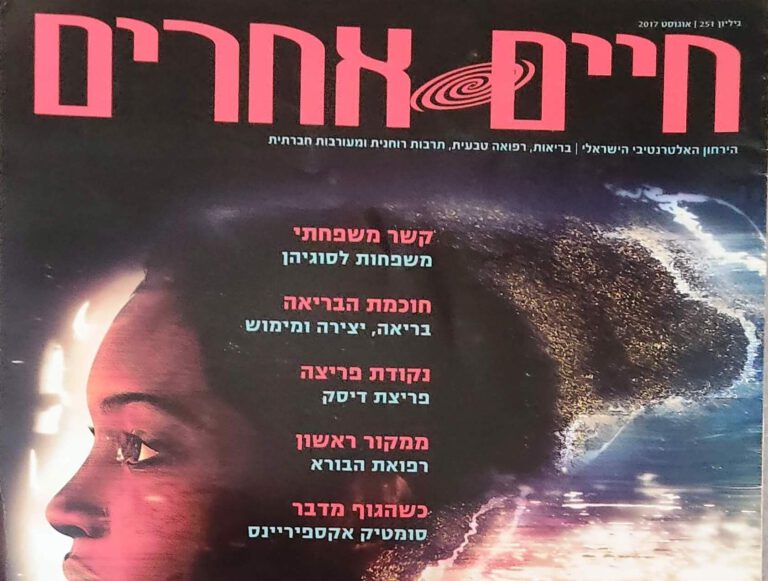
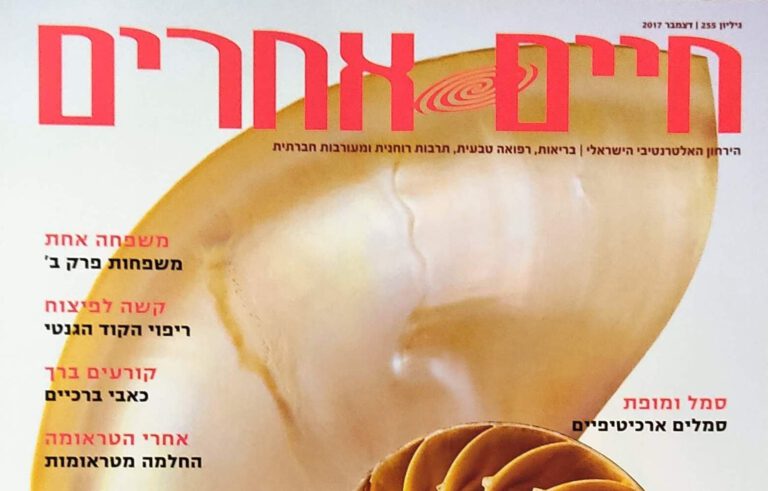

“These people who agreed to tattoo my work on themselves are a kind of erotic messengers for me,” Katzenstein told me a few years ago, and I just observed his arms, tattooed with the enigmatic symbols he had created. In his unique way, he created a hidden grid of his own self, within those around him.
Blood and Tattoos in the Work of Uri Katzenstein – by Yasmine Bergner
Originally published in the online magazine Erev Rav. 2018
Photos from the artist’s archive
Rarely does an artist succeed in building a tangible bridge between their art in the gallery space or private studio and the observer. in a way that allows the creation to accompany the viewer into their home and throughout their later life. This bridge preoccupied the multidisciplinary artist Uri Katzenstein (1951–2018), who recently passed away at the age of 67.
Katzenstein dealt with questions concerning human interaction and the long-term spiritual influence we have, as artists and as human beings, on our intimate and broader surroundings. His work stemmed from a longing for connection, transformation, and healing. This is no small matter in our society, where social, political, and conceptual art reign supreme. During his time in the U.S., Katzenstein was a student of the artist Chris Burden. Burden was also a total body artist—someone willing to get shot and to crucify himself on the roof of a car. Burden and American performance art had a formative influence on Katzenstein’s work and worldview. Katzenstein’s work was distinctly and uniquely body art since the 1980s, which he expressed through sculpture, video, performance, and music. Another significant layer of his work was the art of tattooing.
In the 1990s, Katzenstein created a fascinating artistic project at the Ein Hod Biennale: he offered people from the art world to tattoo an image from his body of work on their bodies—the figure of the “climbing double”. Many art figures accepted. “These people who agreed to tattoo my work on themselves are a kind of erotic messengers for me,” Katzenstein told me a few years ago, and I observed his arms, tattooed with the enigmatic symbols he had created. In this unique way, he created a hidden grid of his own self within those around him. “I gave you a museum, an exhibition, and now I am giving you my body,” Katzenstein quoted a famous curator who participated in the project.
Another of his works tattooed on the body was a sentence written in coded script: “I wanted to talk to you.” The sentence reveals Katzenstein’s engagement with exposure and concealment, with the limitations of language and communication, and with the longing to create an immediate connection between the artist and the active viewer.
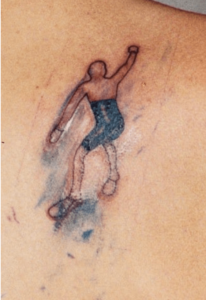
Katzenstein’s climber figure, from the artist’s archive
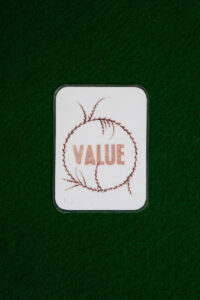
Another unique element in Katzenstein’s work was the use of blood. Blood is a “meta-material” with properties of paint. Blood is the fluid of life, the vessel of the soul according to Judaism, containing our genetic signature and determining our identity. Blood, therefore, is equivalent to identity and essence. It can be said that a large part of Katzenstein’s work dealt with essence or its absence. In his performance from the 1990s, the blood fluid becomes a wall painting in a performative act where the eye follows the hand writing the phrase “Surname,” the anchor of genealogical belonging and our visage before the world. In another work, “Cards,” Katzenstein created a series of cards placed on a ping-pong table set for two players. On the cards, he painted botanical motifs in blood, combined with a single word: “Value.” Value. What legacy, what future will remain after our death—this was a weighty question for Katzenstein. Given that this article was written before his death, the query now carries a poignant weight.
In a conversation with Shani Litman in Haaretz (2015), Yigal Zalmona says: “The body was one of the interesting subjects, and there weren’t many Israeli artists back then who dealt with it. He wasn’t an “Israeli artist” in the accepted sense of the word. His preoccupation with sexually ambiguous definitions, his androgyny—all these were not very accepted and undermined the Israeli macho image […] He was a kind of alien. A combination of a sweet child with a certain type of violence. The impossibility of trapping him between niceness and threat and aggression is one of the most prominent things in his works. His works are “nice”, but also terrifying. A type of absent-minded professor whose art is connected to some New Age quality, an aesthetics of horror movies, dealing with blood in a very clean way. It was very much not ‘Dalut HaChomer’ (The “Poverty of Material” Israeli art concept). Even then, there were many contradictions in his work that were hard to grasp.”
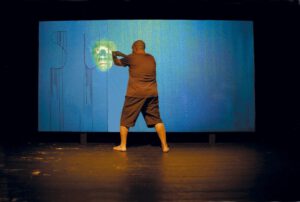
Blood line
The term “Blood line” is used in the tattoo world to describe a line tattooed with water only, without pigment—a line usually used for marking that disappears immediately after healing. A temporary Body Engraving. The concept of “Blood Line” has a double meaning: on the one hand, a “blood line” of a tangible tattoo, and on the other hand, “lineage.”
In Katzenstein’s work, the act of writing in blood suggests an engagement with strange ritual, a private “blood covenant,” and at the same time, the writing on the wall connects the private to the public, exposing blood usually hidden from the eye and raising questions about tribal rituals of impurity and purity. In her important book Purity and Danger, anthropologist Mary Douglas proposed an approach according to which a “defiled” thing is something taken out of its context and natural order. Thus, “mud,” which is not a “dirty” thing usually, becomes “dirty” when it is inside the house. In the same way, blood can be considered “impure” when it is drawn out of the body. Jewish laws of Niddah are based on the principles of impurity and purity. According to anthropological studies in the tribal world, bloodletting and tattooing are purification rituals.
Tattoo anthropologist Lars Krutak notes that initiation and tattooing rituals are closely related to magical perception. “In certain tribes in South America, women were tattooed at the beginning of the moon and during menstruation. This, despite the fact that the monthly cycle made them temporarily exposed to injury by evil spirits. Blood attracts evil, much like an animal smelling blood […] The tattoo and magical pigments were a kind of ‘trap,’ and the moment they were displayed on the skin, they offered permanent purification against future evil spirits, thereby strengthening the woman and the community against evil forever.”
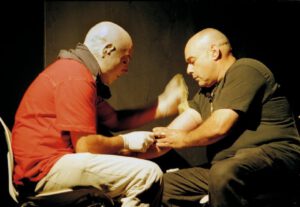
Uri Katzenstein, from the artist’s archive
Katzenstein observed the individual’s relationship with the collective social structure out of contradictory feelings of isolation versus a desire for communication. He expressed a worldview that erupts from an internal center of gravity—radiating outward but also remaining secret and undeciphered. At the center of this melting pot, quantum processes occurred, which, upon reaching a critical point, created metamorphoses in a chain reaction, similar to the effect of a stone thrown into water creating ripples. This basic physical principle deals with the encounter between two pulses that create an interference phenomenon, the passage of a wave through material, in this case, water. As physical beings (made of at least 50% water), we affect each other similarly in a mental sense; our existential ripples meet and connect with the ripples of others at infinite interfaces.
The visual space in which Katzenstein’s figures moved is indeed an ocean. In his fascinating video works, he created surrealistic worlds (with various influences of sci-fi and esoterica), sometimes apocalyptic, but endowed with humor. A strong sense of an idiosyncratic world full of inventions and hybrid chimeras arose from his works. In the work “Order of Cloned Brothers,” he undermined the archetype of family in its traditional sense and offered an alternative consisting of the splitting of the “self” and its reflection in its doubles; the whole world is reflections of the “multi-dimensional self.” His spaces are synthesized, archetypal, existing everywhere or nowhere. The figures move in a space that seems unreal, and sometimes the space is devoid of reality, as in his sculptural installations. The “detail” is that prototype that repeats itself, and only it serves as a mental “all-seeing eye” that connects all things.
Art critic and curator Galia Yahav, who is also no longer with us, was one of the women who wore Katzenstein’s “climbing double” tattoo. In a review she wrote on his exhibition “Backyard,” Yahav said at the time: “Intimacy according to Katzenstein is an impossible or dangerous category. Every nuance—syllable, material, expression, gesture, sound—echoes in a vacuum. But more than that, the entire hyper-action over void is a great show of disability.”
The video “Caretakers,” which Katzenstein created, is accompanied by a soundtrack created in collaboration with Ohad Fishof and Ishai Adar, and brings an intense experiential dimension to the emotionally alienated image and envelops it. Katzenstein sings in a trembling voice a beautiful existentialist lament that threatens to shatter the synthetic apocalyptic scene and dissolve the illusion of isolation. As if the sense of hearing (the high vibration) is trying to overcome the sense of sight (the low vibration) through an experience of true emotion via human voice and music.
Waves, it turns out, are “non-territorial beings.” They share the same space and medium. At one point in space, infinite waves can pass simultaneously. Could it be that Katzenstein searched, like that survivor from the movie “Waterworld,” or like Noah of the flood, for interaction and new life?
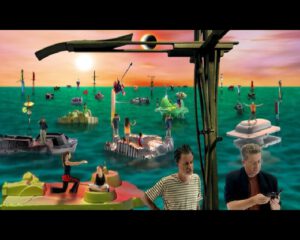
Uri Katzenstein, from the artist’s archive
Katzenstein probably would not have agreed with the claim that there is a shamanic quality in his work, as he told me in a conversation between us. It seems that his perspective always moved on the spectrum between inner knowledge and a lack of faith in the future of humanity. His electrification performances and tattoo rituals stemmed, he said, “from a desire to deal with a space that Fine art usually does not touch—the hypodermic space,” a space of sensation and skin through a shared experience of his and the audience’s.
In an interview with Shani Litman, Katzenstein said: “I am less interested in creating a conceptual boundary between me and the audience. It’s a kind of initiation ritual, very individual and exciting for me […] Many years ago I suggested to curator Naomi Aviv to get a tattoo of a climbing man, and then more people from the art world jumped at my offer and got tattooed, because it was the solution to some fantasy they had. The tattoos were the first time I made an intrusion into the hypodermic space, and I understood that this is what I am interested in doing.”
According to ancient tribal belief, only shamans and tattooers had the power to control human souls, therefore the tattooer was an active partner in a special socio-religious order where the body, ritual, and tattoos were connected to tribal cosmology and nature, to a place where moral obligations to gods and goddesses, to mothers and ancestors, to living spirits and the earth itself, were connected within a whole system. To a great extent, from this spiritual core, tribal life and the tattoo culture developed.
Initiation rituals help us move safely from one developmental stage to another and accept it with mental maturity. In Western culture of our time, there is insufficient understanding and internalization of rites of passage and initiation. This spiritual deficit largely expresses the existential separateness experienced by people today. Physical, mental, and spiritual transformations that we all experience during our lives happen to us without initiation, without sufficient spaces for healing trauma, and without community-serving leadership. To a large extent, Katzenstein’s performance actions, his tattooing, and his electrification shows were intended to create and distill a meaningful, authentic, and humorous moment between the artist and the active viewer; an intimate interaction aimed to be etched, to influence, and to heal, similar to rites of passage and initiation.
His works suggest that the most missing or absent element in the world – is connection between individuals. It is unclear if the deficit is in social skills or if it stems from a lack of ground and space to allow it. Perhaps the reason why Katzenstein’s ritualistic performance is experienced as an “opaque” or coded action is our distancing from this socio-spiritual cosmological order. We experience space as “void,” but every void is a bed that can fertilize new life.
Once, Katzenstein asked me to send him traditional tattoo songs that I know. Here is a song that seems appropriate here, a Micronesian folk tattoo song in my translation:
“Cease your wailing and your sighing, my friend,
This is not the pain of the sick man,
This is the pain of the student!
Relax your body in devotion,
Surrender, O leader!
Soon you will receive the chains of your beautiful ornaments,
But for now, they are still separate and unconnected.
The string is still interrupted and incomplete
Surrender, O leader!
Soon at the fall of evening
You will gaze upon your tattoo
Fresh as a Ti leaf
Surrender, O leader!
Ah, if it were a burden,
I would carry it for you in my love,
Oh, be silent and surrender.
I will cease with the ending of the tapping
Surrender, O leader!
Like the water flowing with the blood
I ache for your condition.
Surrender, O leader!
The chain will break, the thread will snap,
But the tattoo will remain.
This ornament will be eternal
And go with you beyond the grave.
Surrender, O leader!
Ah, you suffer under the tapping
Ah, until you fall asleep
And are no longer weary and tired of it!”
Yasmine Bergner is a spiritual guide through the art of tattoos,
multidisciplinary artist, art therapist and tattoo culture researcher.