


“Wetiko” is a concept originating from the Cree tribe in North America, a word expressing a psychological disease affecting human behavior that is destructive to itself. Our collective human psychosis.
Wetiko – The Greatest Epidemic Known to Humanity – by Paul Levy
Hebrew translation: Yasmine Bergner
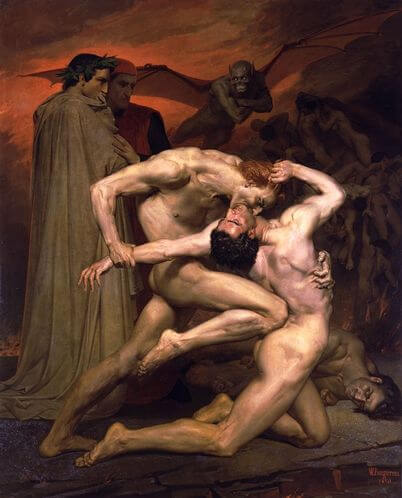
Opening image: Bouguereau, Dante and Virgil in Hell, 1850
In the book Columbus and Other Cannibals, the indigenous author Jack D. Forbes [1] vitally investigates a psychological disease affecting human behavior that is destructive to itself, which the indigenous people of the American continent felt on their own flesh for years. After reading the book, it was clear to me that it describes the same psycho-spiritual illness of the mind that I wrote about in my book The Madness of George W. Bush: A Reflection on Our Collective Psychosis. In it, I presented the idea that since the dawn of human history, our species has fallen victim to a collective psychosis, which I call “malignant egophrenia.” Speaking about this same mental epidemic, Forbes writes: “For several thousand years, human beings have suffered from an epidemic. A disease more terrible than leprosy, worse than malaria, harder than smallpox” [2]. Indigenous cultures have identified this same mental virus [3], which I call Malignant Egophrenia, for many hundreds of years. They call it “Wetiko” – a term from the Cree tribe referring to a negative person or entity that imposes terror on others. Professor Forbes, who was one of the founders of the American Indian Movement in the 1960s, says that “tragically, human history in the last 2000 years tells the story of the epidemiology of the “Wetiko disease” [4].
Wetiko / Malignant Egophrenia is a “Psychosis” in the true sense of the word, as it is a disease of the spirit / mind. Although we use different names, Forbes and I are trying to point to the same illness of the mind which lies at the root of humanity’s inhuman behavior toward itself.
As we come to investigate the Wetiko entity, we must awaken its spirit and enter into a relationship with it, just as if we were performing a magical ritual. We must contemplate and engage with Wetiko in the most objective way possible, just as if it existed outside of ourselves. Because of its unique psychological origin, the epidemiology of Wetiko is very different from any other disease. A fundamental challenge to our investigation of the Wetiko virus is the fact that it revolves within the mind, which is itself the instrument we use for our investigation. Referring to the paradox inherent in this, Forbes says he aspires to study the disease from a perspective that is as free as possible from assumptions created by the disease we are studying [5]. If we are not aware of the viewpoint from which we are examining the Wetiko virus, our investigation will be infected by the virus itself and will cloud the sharpness of vision needed to begin the healing process. We must learn how Wetiko embodies itself in others and how it embodies itself within us; this will allow us to see it with greater objectivity. Observing the ways in which the psychological disease manifests in the world is a mirror through which we can potentially recognize the same disease rising subjectively from within our own consciousness.
Hans Ulrich
In awakening an entity like Wetiko, if we want to examine it as objectively as possible, we must hermetically seal it within an alchemical vessel. This ensures that its mercurial spirit does not evaporate back into the hidden unconscious, where it would act upon us and through us. Jung consistently emphasized the importance of developing a vessel designed to contain disturbing spirits such as Wetiko. K. G. Jung suggests shifting the disturbing spirit from its place and placing it within a vessel located at a distance between the individual and their neighbor. “For the sake of humanity, we must build such vessels where we can place all this vile poison. Because it must always exist somewhere. Not to trap it, to deny its existence, gives it the best chance to grow” [6].
Wetiko is an elusive entity, and it is very challenging to focus the gaze on its essence, yet it is very important to analyze it into its components. Unlike a physiological virus, the Wetiko virus cannot be isolated materially, but its unique characteristics can be discerned and discovered through the extraordinary actions of the mind that is under its spell. Not acknowledging the existence of the Wetiko germ—to say that “it does not exist”—allows the mental infection to manifest in action (acting out) without restraint. Being “always everywhere” means being non-local, always around, even potentially and especially within ourselves. By awakening the spirit of Wetiko, we simultaneously create (through the personal investigation itself) the vessel we need to study the germ and understand what we are actually dealing with. We learn how it operates in the world, in others, and subjectively—within ourselves. In order to complete the circle in this exercise/exorcism [7] of observation, we must homeopathically return the gaze inward toward ourselves. Like in a dream where the inside is the outside, we can understand that the Wetiko virus we observed “in the outside world,” outside of ourselves, is a reflection and exists in interaction with this process within ourselves. Within the symptomatology of the Wetiko virus, deep insight is encoded, something essential that we must know.
A Disease of Culture
Wetiko / Malignant Egophrenia is a disease of culture, or of its absence. To quote Forbes loosely: “The development of the Wetiko disease strikingly parallels the rise of civilization through Western eyes; this is not a coincidence” [8]. The nature of industrial society is unsustainable and requires more and more violence in order to sustain and maintain it. The true meaning of society is, simply, not to kill people. Referring to the lack of culture in modern society, Gandhi was asked what he thought of Western civilization. His answer was, “I think it would be a good idea.” It makes sense that indigenous peoples knew of the existence of Malignant Egophrenia, through which they were oppressed, but at least in the beginning, they were not under the bewitching influence of Western culture. Living under the control of modern culture can feel as though something foreign to our nature is being forced upon us, or as if we are living in occupied territory. Modern culture suffers from a primarily one-sided dominance of rationality, of the intellectual mind. A one-sidedness that ostensibly disconnects us from nature, from empathy, and from ourselves. As a result of its dissociation from the holistic whole, the Wetiko disease is a disorder of the order of humanity and the natural world. It is a disease that spreads aggression and can ignite violence among living creatures. The Wetiko virus is the root cause of the inhumanity found at the heart of human nature. This “mental virus,” this system failure, informs and illustrates the madness of the so-called society, which in a feedback loop perpetuates and feeds the madness within itself.
Forbes continues: “This disease, this (cannibalistic) psychosis called Wetiko, is the disease of the most epidemic magnitude known to man” [9]. We, as a human species, are in the midst of a widespread mental epidemic. A contagious collective psychosis that has been brewing in the cauldron of the human mind since the dawn of days. Like a fractal, Wetiko operates in multiple dimensions simultaneously: in the intra-personal dimension (within individuals), the inter-personal dimension (between individuals), and the collective dimension (as a human species). “Cannibalism,” in Forbes’s words, is “the consumption of the life of the other for personal gain” [10]. Those infected with the Wetiko virus, like cannibals, consume the life force of the other—human and non-human—for personal purposes or profit, and do so without giving anything in return from their own lives. One example that symbolizes the madness of collective self – destruction is the destruction of the Amazon rainforest by oil companies, the lungs of planet Earth. This is a living example that strikingly illustrates what we are doing to ourselves. Another tangible example that symbolically embodies the Wetiko complex in action is the genetically engineered sterile seeds of the Monsanto corporation, which are prevented from reproducing into a second generation of seeds and force farmers to buy new seeds from the corporation again and again for the coming year’s harvest. This agricultural terrorism makes it very difficult for small farmers to survive and has ignited a wave of suicides among farmers, while Monsanto corporation only grows and steadily enriches itself in the process.
Forbes writes: “The compulsive / trampling characteristic of Wetiko is the fact that it consumes other human beings, or in other words, it is a kind of predator and cannibal. This is the central essence of the disease” [11]. Predators, Wetiko entities that embody themselves overwhelmingly, are not in contact with their humanity, and therefore are unable to see humanity in others. Instead, they treat others as potential prey or as a threat to their dominance. Individuals fully infected with Wetiko psychosis consume the lives of others physically, emotionally, mentally, and metaphysically – beyond the material body and physical assets – to the level of meaning itself. Wetiko victims are the anti – artists of our culture. They embody the opposite of what creative artists do. Unlike an artist who creates life – affirming meaning and enriches the world without robbing others (see my article: The Artist as World Healer), Wetiko consumes and takes without giving anything in return, steadily depleting and emptying the world of its resources.
We are currently in the midst of the greatest epidemic disease known to man (see my article: Diagnosis: Mental Epidemic). Many of us are not aware of this, because our collective madness is so widespread that it has undergone “normalization.” Our collective madness has become transparent to us, while we see and interpret the world through it, making our madness invisible, and inadvertently conspiring with the collective psychosis that sows destruction and death on our planet. Being “transparent,” our madness is far beyond visibility; it is invisible. Our collective psychosis is invisible to us because it expresses itself both in the way we observe and in the way we are conditioned not to observe. Thanks to its cloak of invisibility, we fail to notice our madness, a mental blindness that makes us partners in creating our madness.
Many of us are unable to grasp the scale of the evil to which Wetiko – filled entities have fallen victim and what they are capable of. Our inability to imagine the evil that exists potentially in humanity is a direct result of a lack of intimacy with the potential for evil that exists within us, which allows the cruelty of Wetiko to rule without restraint in our world (see my article: Shedding Light on Evil). Through our mental blindness, we become partners in spreading the evil of Wetiko psychosis, a systemic evil whose depth reaches far beyond the ability of words to describe. Evil paralyzes our ability to verbalize the experience and creates an ostensibly unbridgeable gap between language and the event described. In finding the place where language fails, we discover and create a new language, a universal language that transcends language itself – a language known as art.
A Parasite of a Different Order
When people are infected with the Wetiko virus, Forbes writes, they become the “hosts” of the Wetiko parasite [12]. The Wetiko virus is a kind of mental “worm”, a parasite of consciousness. Similar to computer viruses or malware infecting and programming a computer to destroy itself, a consciousness virus like Wetiko can program the human biological computer to think, believe, and behave in ways that result in self-destruction. Wetiko is a contagious mental pathogen that sneaks thought – forms into our consciousness that activate and feed it, and eventually kill the host (us). The pathogen does not want to kill us too quickly, because in order to successfully carry out its agenda, to reproduce and spread itself in space, it must allow the host to live long enough to spread the virus. If the host dies too soon, the virus will be evicted prematurely and will suffer the inconvenience of finding a new home.
Like a cancer of the mind that sends out metastases, in Wetiko disease, a pathological part of the mind attaches and incorporates all healthy parts to itself to serve its pathology. The personality reorganizes a coherent external display around the pathogenic core, hiding the internal dysfunction and making it very difficult to identify. In this military coup of the mind, the Wetiko virus displaces the personality and takes it over, and it becomes its puppet. Like a parasite, the Wetiko virus can take over the free will of an animal more developed than itself, thereby making it a servant of its malicious agenda. Once the parasite is well-rooted within the mind, the main command coordinating the person’s behavior comes directly from the disease, which is now the one pulling the strings. Just as a person infected with the rabies virus will resist drinking water that could wash away the infection, a person infected with the Wetiko virus will refuse any help that could assist them in getting rid of the disease. Wetiko patients are phobic toward the light of truth, and they avoid it like the disease itself. In advanced stages, this process takes over the person completely until we can honestly say that the person “is not really there,” but rather an empty shell functioning through what looks like a human being. The person now identifies completely with their mask, their persona, but it seems as if there is no one behind the mask.
Hans Ulrich
A Foreign Intrusion
The spiritual teacher Don Juan, in Carlos Castaneda’s books, speaks in his own language about Wetiko. He says that the ancient shamans made it clear that this is “the subject of subjects” [13]. Don Juan explains: “We have a life partner… We have a predator that came from the depths of the universe and took control of our lives. Human beings are its prisoners. This predator is our ruler” [14]. It seems this is the same state of affairs described in the New Testament, when in the Gospel according to John, the Devil is referred to as the “ruler of this world” (14:30; 16:11). Paul speaks of the Devil as the “god of this world” (2 Cor. 4:4). The Gnostic Gospel of Philip says that the root of evil originated from within us, implying in fact that if we do not recognize the evil, “it rules over us, we are its slaves, and it takes us captive” (II, 3, 83.5-30). Speaking of the predator, Don Juan continues: “It has made us submissive, helpless. If we want to protest, it suppresses our protest. If we want to act independently, it demands that we do not do so” [15]. It is impressive how Don Juan explains how the influence of Wetiko is expressed in our society, which is becoming increasingly militaristic. Our freedoms and rights are being taken away from us, just as if there is a latent and internal unmanifested archetypal pattern within the human mind that embodies itself in and shows itself through the external world. To quote Don Juan: “We are indeed prisoners! This was an energetic fact for the sorcerers of ancient Mexico” [16]. Don Juan refers to an “energetic fact,” in the sense that we can all connect to it, “something” within us that prevents us from expressing our inner genius creativity and realizing our full potential. These “predators” are “time thieves,” stealing the precious hours of our lives, as if we are wage slaves on a prison planet “doing time.” Deepening his description of these “predators,” Don Juan continues: “They gave us their mind, which became our mind” [18]. Just as if they are in “competition” with us to share a piece of our mind. The predator changes shape and is fashioned according to our shape, and if we are not aware of its disguise, we will identify with its intrusive thought-forms as if they were ours and act upon them. We will mistakenly think that we are acting according to our own impulses, with the best of intentions. This predator, Don Juan continues, “fears every moment that its moves will be discovered and food will be withheld from it” [19].
The Wetiko predator is driven by an internal and compulsive necessity born out of terror that continues to feed itself out of a desire to delay its expected death. Don Juan continues: “Through the mind, which is ultimately their mind, the predators insert into human beings what is convenient for them (the predators)” [20], hiding themselves within our form; this predator penetrates under our skin, disguising itself beneath us, deluding us into recognizing the false version of ourselves (that is why the abbreviation of Malignant Egophrenia is “ME disease,” and it refers to the distortion of our identity—our sense of “I AM”). Instead of being in our power and in service to others, we become servants of the predator. Instead of recognizing our inner authority, and the creation of reality from our thoughts, we are formed by them, because the predator thinks for us and sits in our chair.
Remedios Varo
Speaking of the predator’s conspiracy, Don Juan says: “It offers something, agrees with its own premise, and makes you believe that you did something of value” [21], just as if there is a foreign presence within us, a metaphysical alien entity, invading subliminally into our consciousness until we identify with it completely and disconnect from our own consciousness. Don Juan refers to this state as a kind of “foreign installation,” as if an alien race had set up a station within our consciousness. This is what the Gnostics (“the knowers”) meant when they spoke of a foreign entity they called “Archons,” infiltrating into our consciousness [22] to the level that we are not aware that a foreign entity has taken control of our mind. We are recruited against our will to the dark agenda of the predator, inadvertently becoming its slaves. This internal state of war happening within the mind echoes and is reflected through the psychological moves and dark forces we witness in the external world. This disease is fed by our lack of awareness of it.
Vampires
Forbes writes: “Wetiko psychosis is a disease of the spirit that takes human beings down an ugly and heartless path… After all, Wetiko disease turns human beings into werewolves and vampires, creatures from the world of European nightmares and creatures from the Wetiko reality” [23]. Werewolves and vampires are shapeshifters, symbolic representations of the threatening potential existing in the heart of us all, which is liable to take over and embody itself in action as the archetypal “shadow,” returning us to a regressive state of mind of being like a predator or a sub-human creature. When these pre-human mental energies erupt into consciousness and are not mediated by the conscious, Jung writes: “They sweep away everything before them like a flood and turn human beings into creatures for whom the word ‘monsters’ is too good a word” [24].
Vampires, considered the darkest creature in the arsenal of evil, have drawn our imagination for many hundreds of years, because they represent a living process existing in the heart of the human mind. A vampire is not a human figure but a soulless creature, an entity that has lost its soul, and if it has not lost its soul, it has become “cursed”, which means the loss of a soul. Either way, something is missing. Isolated from the world, it has lost the connection with the part of itself that communicates with everything else. From its point of view, the world exists simply for its use. Although it has lost its heart and soul, the vampire has not lost its consciousness (although in a certain sense it has), since vampires are often endowed with a sharp intellect that hides their pathology and makes it hard for us to see it. This is similar to the way in which people in a deep state of trauma can be blessed with a brilliant mind, a gift that makes it easier for them to hide the scope of their trauma and makes it difficult to diagnose their illness. Instead of the vampire’s sharp mind being dedicated to developing inner insights into the illness and healing from it, it is dedicated to passing the illness along and spreading its dark art. As a kind of living-dead, the vampire is death taking the form of human life. The Wetiko virus is not, in the end, something alive, but a living form of death. Like a virus, Wetiko is “lifeless” matter. Because only within living creatures can viruses sustain “life-by-proxy.” A vampire is a kind of living-dead. Like a mature vampire, developed Wetiko entities have been stripped of their humanity and have become a conduit for the impersonal and transpersonal Wetiko virus to revolve and act through them. They have become a living portal, an opening torn into the three-dimensional fabric of space and time through which a multi-dimensional contagious virus spreads locally and non-locally in the field.
Lacking a soul dimension, Wetiko entities are efficient “machines,” dedicating themselves to the service of “the State”, which [to quote Forbes] is itself a Wetiko entity that has taken over the mechanisms of power” [25].
A mature Wetiko becomes a robotic automaton, conditioned to react to reflexive stimulation. They become part of “the machine,” without spontaneity, creativity, originality, or free thinking. Wetiko entities undergo a process of dehumanization and lose contact with the sense of aesthetics and with the ability to appreciate the inherent beauty of life, becoming “an-aesthetic,” devoid of feeling and emotion for everything that is human. Messengers of a patriarchal, military, and authoritarian planetary “society,” the Wetiko germ spawns fascism and terror. To quote the great healer Wilhelm Reich: “Fascism is the vampire that attaches itself to the living body. The urge to kill gains absolute control” [26]. Fascism is the external collective political expression of the destructive inner landscape of an individual who has been oppressed and maimed by the authoritarian civilization of “the machine.”
Like a vampire, in a mature Wetiko entity “there is no one home,” and this is one of the reasons why, symbolically, vampires have no reflection in a mirror (which, from a mythological point of view, reflects back an image of the human soul). Mature Wetiko people are empty to the bone, so there is nothing that can be reflected. Internally, there is only an infinite void, a sponge that can never absorb, a devouring black hole that feeds on the universe. Their degenerate soul has been emptied of content like a hollow tree trunk emptied by mental termites. Mature Wetiko people are compulsively haunted by the unconscious in its destructive version, denying consciousness in a way that they are unable to see or experience themselves, which the philosopher Hannah Arendt argues is one of the main characteristics of evil. Devoid of the ability for self-observation, they have no access to the mechanism of the mind that allows this action. One of the reasons why we cannot see a vampire’s reflection in a mirror is because our inner unconscious vampire dims the reflection, and the meaning is that the ghost of the unacknowledged “shadow” of ourselves blocks our gaze.
Leonor Fini
A vampire casts no shadow. In order to cast a shadow, there must be a source of light. Inside a vampire, there is no light, only infinite darkness. Because it is not a living creature, a vampire has no inherent reality, no essence. Only an object with essential existence can produce a shadow. Vampires cannot cast a shadow because they are the living embodiment of the “shadow” archetype. A shadow cannot cast a shadow itself and is devoid of essence. There are certain advantages to a vampire not casting a shadow – it allows it to hide its true identity more easily, to move between shadows, to become invisible, and to lie in wait for people. The vampire, a shapeshifter and master of disguise and camouflage, can more easily seduce and mislead the innocent, just as a sugar-coated vampire traps us using our unconscious “shadow” and blind spots. In this sense, denying our “shadow” can lead to energetic vampirism. The vampire archetype is activated within us when we turn our back and deny our inner darkness and make it invisible to us. We fail to see vampires because we chose not to see the dark “vampiric” aspects within ourselves. Our unwillingness to see the “vampiric” qualities within ourselves blinds us to the “vampiric” traits in others.
In addition to the weak and defenseless, the vampire also seeks those who are on the verge of a quantum evolutionary leap in consciousness but have not yet managed to integrate their insights and “come out on the other side.” Such human beings are in a charged and sensitive state energetically. The openness of their heart and their vulnerability invites vampiric entities to covet and feed on the light of their expanding consciousness. The strategy of these predators is to divert our attention outward, thereby preventing us from recognizing our inner light, which would “kill” the vampire. If we hold up the mirror and reflect the madness projected onto us by the people suffering from it, we risk being the ones labeled “crazy.” If we manage to gain access to the light within us and try to share it with others, it is possible that non-local vampiric entities (what I previously called non-local demonic entities) which are not limited to three-dimensional existence and the laws of space and time will try, through their access to the non-local field, to block us by influencing other human beings to act against us. This process is liable to destroy us, unless we have the meta-awareness to see it in action—to have the skill to navigate our way wisely—and this will deepen our resilience and intent, deepen our covenant with the light of clarity, and strengthen our creative ability to broadcast our insights and cultivate compassion and openness of heart. It seems as though those non-local mental vampiric entities are the guardians of the threshold of evolution.
Just like vampires, mature Wetiko entities feel an intense thirst for the very thing they lack – the mystical essence of life, the “blood” of our soul. By coveting other human beings, Wetiko disease is a kind of mental “eating disorder,” where the damaged mind “consumes” other souls, and ultimately itself. Wetiko entities are a kind of “soul-eaters,” destroyed by the wildness of their ceaseless hunger, by their insatiable appetite. This vampiric feeding is an unnatural parody, a demonic reflection of the self-renewal of life. This unnatural internal process is projected onto us collectively by the consumer society we are part of, a culture that relentlessly fuels the flame of ceaseless craving, conditioning us to always want more. We are in a feeding frenzy, trying to fill a bottomless void, as if we are starving. This violent process of obsessive / compulsive consumption is a mirror of a shared, deep, internal sense of spiritual hunger. The entity of the global economic system itself is a living symbol of uncontrolled Wetiko disease in action.
In vampiric lineage, self-replication is achieved through the family system (family of origin, or the human family). The legacy of abuse (physical, sexual, political, psychological, or spiritual) is passed between generations personally and collectively, steadily rolling between lives. The Wetiko virus passes along its broken logic and its distorted code into the bodymind of the other through the traumatic shattering of our wholeness. Our species suffers from an inherited collective PTSD, just as if it were under a curse.

Francesco Goya
High Risk of Contagion
Speaking of Wetiko, Forbes says: “They are not sane in the true sense of the word. They are mentally ill and, tragically, this mental illness they carry is contagious” [27]. Wetiko psychosis is, as mentioned, highly contagious, spreading through the channel of our collective unconscious. The pathways of contagion and spread do not move like a physical pathogen. This nomadic wandering germ moves in a “plasmatic” way, penetrating and feeding on our unconscious blind spots and strengthening them in a feedback loop, and thus spreading itself in the field non-locally. In Wetiko, there is a “code” or a certain logic that influences/infects consciousness in a way parallel to how the DNA of a virus passes and infects the cell. People who communicate the frequency of Wetiko align with each other through psychic resonance, which strengthens the shared consensus and maintains their distorted perception of reality. As they cooperate with their shared psychosis, groups of people gathered together by the unconscious could potentially become a socio-political force to be dealt with. When a group of people is in agreement, regardless of whether it is true or not, their alignment with each other creates a contagious magnetic force-field that is liable to sweep up and magnetize the unconscious person toward it.
People who have been taken over by the Wetiko virus usually do not suspect that they have been “scammed.” Wetiko culture does not offer them any incentives to examine themselves and contemplate their sad state. On the contrary, the non-local field programs itself to conspire and allow the continued nurturing of the psychosis. When someone is a full Wetiko entity but does not recognize it themselves, the field around them twists in order to protect, conspire, and feed on the psychosis in a way that leaves those around them in a trance.
Under the spell of Wetiko, they lose the ability to recognize Wetiko pathology in others. In a situation of “social narcissism,” Wetiko entities at different stages of the disease take certain positions and roles relative to others, with the goal of protecting themselves from their own madness and darkness. They strengthen and feed each other’s narcissism, because it strengthens their own. Forbes writes that the type of personality that is typically liable to fall victim to the Wetiko virus is the individual whose “strings are pulled by others, or those who walk a life path dictated by others. They are the ones who are ripe for the Wetiko virus” [28]. Because they are not in contact with their inner guidance, they project authority outside of themselves and become very prone to influence regarding consensus opinion and the agreed-upon opinions of the dominant group. Because they have lost the ability for internal discrimination and critical thinking, the “masses” become a mindless herd and fall victim to groupthink, whose members enable, in the form of codependency, their version of the world (Wetiko). Their group consensus on the nature of reality becomes harder and harder to maintain as time passes, but like a house of cards about to collapse at any moment, their perception of reality is based on a fundamental error. Strangely, people subject to the collective enchantment of Wetiko sometimes become fanatic supporters of an agenda that is completely contrary to their own interests. This is an external reflection of the internal state of being subject to the seduction of self-destruction caused by the Wetiko parasite.
It even seems as though a holy-less, negative, or “unclean” entity has taken control of the person subject to Wetiko and resides in them. Such people are exploited against their will as tools, as secret agents of this dark and unclean entity, to allow it to spread itself in the wider field. As secret agents of the disease, the secret of Wetiko is a self-secret, a secret they hide even from themselves. Just as sometimes something larger than us takes control of us, so Wetiko victims do not know how much they are controlled in every moment. The experience of being controlled by something vast, larger than you, happens in their blind spots (see my article “Are We Possessed?”).
Francesco Goya
The Wetiko germ affects our perception by stealth and deceit with the goal of hiding and confusing us from being seen. Wetiko sows its seeds and strikes root within consciousness. Like mental vegetable foliage, it covers, distracts us, and diverts us from the calling of our true destiny and from our spiritual path. The alienating and alien effect of the Wetiko virus, exactly the thing we must notice, hides within the perception, the thought, and the meaning we attribute to our experience. When someone has fallen as a full member into a Wetiko “cult” (see my article “The Bush Cult”), it seems as though their consciousness has been populated by the virus in such a way that they have no faint clue about their pathological state. Wetiko entities do not perceive themselves as needing help; for them, other people are always “the problem.” Their disease does not bother them, and they do not recognize it, because it is all they know, and their leaders and the society in which they live encourages them. They have no assessment of their disorder, and they do not understand how sick they are.
Forbes writes: “One of the central traits characterizing the extreme negative form of Wetikoism is arrogance” [29]. Full Wetiko entities are wrapped in self-importance, “inflated” tools of evil, and arrogantly, ignorantly, and self-righteously, they are sure that they are acting in the service of truth and the general good. It seems they fail to perceive the negativity of their actions and think that everything they do is good. Forbes concludes: “In any case, Wetiko disease, the disease of exploitation, has been spread widely in the last several thousand years. Because we are not vaccinated against it, it seems to be getting worse with time. More and more people are infected with it, in a more wide-ranging way, and those people become the teachers of the younger generation” [30]. Wetiko cultures are taught both at home and in “academia,” where people become “qualified” in the depths of this world and therefore receive credit and empowerment in spreading the corrupt ways in a more wide-ranging way than ever before.
Writing about the wide-ranging spread of the Wetiko virus, Forbes writes: “It is spread by Wetiko entities themselves, who recruit and corrupt others. It is spread through history books, television, military training programs, police, comic books, pornographic magazines, movies, right-wing movements, fanaticism of various types, high-pressure missionary groups, and countless governments” [31].
All mainstream corporate institutions, subject to social sanctions, are in the business of indoctrination (brainwashing), telling us what to think and what not to think, and of course, how to think. Our consciousness is fashioned into a certain form by the dominant society, and it seems that our “true face” undergoes a facelift. We are robbed of our spiritual abundance. It seems our society has become the mouthpiece for the propaganda organ of the disease, hypnotizing us into being convinced into this perception while we drain what is more important than anything else in the world. The culture that informs and is fashioned around Wetiko disease is itself a channel for its spread. If we sign on the dotted line and act according to its life-denying perception, it will finally consume us, and we will become the extensions of its orders. This is how the “mental empire” of the collective psychosis operates, spreading itself and expanding, trying to approach full distribution.
Full Wetiko entities can be petty tyrants at home or at work, but can also be on the depleted and oppressed side that exercises no power in the world around them. When Forbes speaks of “Big Wetikos,” he refers to full Wetiko entities who have “climbed the Wetiko ladder,” jumped through the Wetiko hoops, and risen in Wetiko status, finding themselves presiding over positions of power through which they can influence and control events in our world and operate the system. “Big Wetikos” who navigate the levers of control, whether they are the wealthiest, corporate executives, bankers, or heads of state, are particularly dangerous because they define the terms of the dialogue and control the reigning historical narrative. They manage our perceptions through the propaganda engines of the mainstream corporate media controlled by them (see my article “The War on Consciousness”). Big Wetikos in positions of power create the boundaries of discourse and debate. Wetiko is an ideological virus whose currency is conceptual syntax.

Grant Morisson
Wetiko shifts our mental syntax, the laws of our language creation, and therefore distorts the semantics (grammar), the meaning we attribute to our experience of ourselves and the world. Wetiko is a semantic disorder because it changes the axioms through which the mind fashions, projects, and bewitches the words, and from there draws the experience. The thought-forms and beliefs that express and represent the viral Wetiko act as an inherent system of control, fashioning the boundaries of the imagination of what we experience as possible, as individuals, as nations, and as a human species. Wetikoism supports and perpetuates the myths, stories, dogmas, and the (non) sacred books that validate their self-serving agenda. Books and other forms of information that do not support the Wetiko version of the order of things are metaphorically “burned” (or literally in some cases—as in the case of the books of Dr. Wilhelm Reich mentioned above, which were burned by the United States government. In describing what he called “the mental epidemic,” Reich pointed in his own way to the evil of the Wetiko virus).
We live within a world which, similar to a dream, constitutes an interactive mirror inseparable from our internal personal entity. As a reflection of a deep state within ourselves, Wetiko is an unmediated phenomenon, a direct manifestation of the dream-like nature of the universe, and this is the deep understanding that Wetiko shows us. Recognizing the dream-like nature of our situation produces a living antidote made of consciousness that is personally fashioned in order to neutralize the mental pathogen of Wetiko. In other words, within the pathogen itself is found an insight, a revelation, which is the cure for the disease (please see my article “Shadow Projection is its own Medicine”). The self-recognition of Wetiko offers mental healing, but in order to enjoy the benefits of the cure, we must recognize and understand deeply the miracle of maintaining psycho-spiritual health. How amazing it is that the thing that can potentially destroy us is simultaneously what wakes us up. A potential catalyst for our evolution as a human species, we all create and dream Wetiko together. Wetiko is truly a quantum phenomenon, in that it is the most lethal poison and the most healing medicine, joined together. Will Wetiko kill us? Or will it wake us up? Everything depends on whether we recognize what it potentially reveals to us. The prognosis for Wetiko/malignant egophrenia depends on the way we dream it.
Now, when we have in our possession the understanding and the knowledge (dia-gnosis and pro-gnosis), all that we need to do is to discover the cure, a thing which in itself requires understanding (gnosis).

Grant Morisson
All rights reserved to Paul Levy
Translation: Yasmine Bergner (Flop to Hebrew version)