

Here is the article in English, maintaining the original structure, formatting, and the image code blocks as requested.
Opening Image:
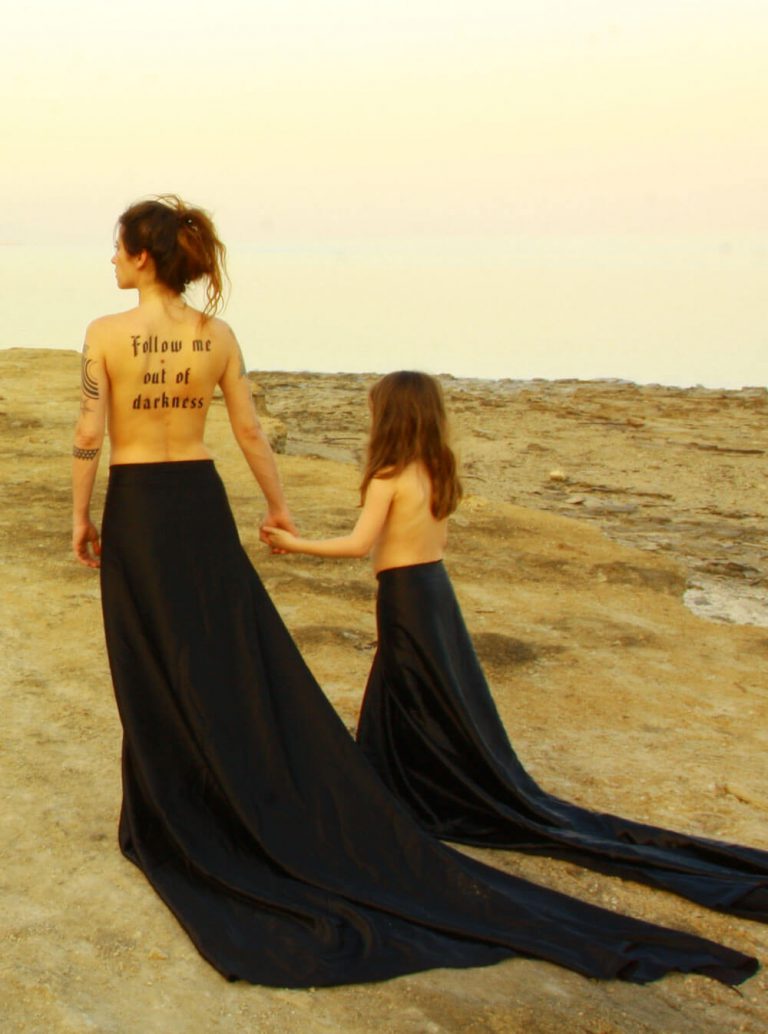
Yasmine Bergner, Follow me out of Darkness, 2013, Photography: Jude Moskovitch
Many do not understand that the fundamental issue underlying women’s empowerment is the Mother Wound.
Difficulties and challenges between mothers and daughters are violent, unbridled, and widespread in society, yet they are rarely spoken about openly.
The taboo regarding speaking about the pain of the Mother Wound is what keeps it in place—hidden in the shadows, festering, and out of sight.
What exactly is the Mother Wound?
The Mother Wound is the wound of being a woman, passed down through generations of women in patriarchal societies.
It includes the dysfunctional coping mechanisms used to process that pain.
The Mother Wound includes:
Comparison: A feeling that I am not good enough
Shame: A constant background feeling that something is wrong with me
Diminishment: A feeling that I must stay small to remain loved
A constant sense of guilt for wanting more than what I have right now.
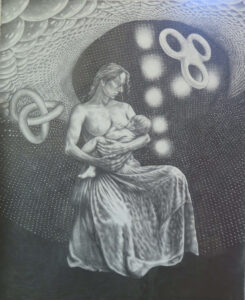
The Great Mother, Pencil on paper, 2016, Yasmine bergner
The Mother Wound can also manifest as:
Not experiencing your full self because I do not want to threaten others
Having a high tolerance for bad behavior from others
Emotional care-taking
Competitiveness with other women
Self-sabotage
Rigidity and over-dominance
Symptoms such as eating disorders, depression, and addictions
In our patriarchal male society, women are conditioned to think of themselves as less valuable than men, unworthy, or lacking in value. This sense of diminishment has been internalized and passed down through countless generations of women.
The social atmosphere of female oppression places the daughter in a double-bind conflict.
Simply put, if a daughter internalizes her mother’s unconscious beliefs (in a sense, a form of “I am not good enough”) then she has her mother’s approval, but in a way, she is betraying herself and her potential.
But if she does not internalize her mother’s unconscious beliefs about their limitations, but instead affirms her own power and potential, she is then aware that her mother may feel this unconsciously and view it as a personal rejection from the daughter.
The daughter does not want to risk losing her mother’s love and acceptance, so the internalization of these diminishing, unconscious beliefs is a form of “loyalty” and emotional survival for the daughter.
It may feel dangerous for women to realize their full potential because it risks some level of rejection from the mother.
This happens because, unconsciously, the daughter feels that fully empowering herself will trigger feelings of sadness or rage, due to parts of herself that the mother had to relinquish in her own life. Her compassion for her mother, the desire to please her, and the fear of conflict may cause her to convince herself that “it is better to shrink and be small.”
A common resistance to confronting the Mother Wound is the desire to “leave the past in the past.” But in reality, we can never truly escape or bury the past. If we avoid dealing with the pain inherent in one of the most ancient and fundamental relationships in our lives, we lack the critical opportunity to discover the truth of who we really are, and to live that truth with authenticity and joy.

Yasmine bergner, Follow me out of Darkness, 2013, Photography: Jude Moskovitch
Stereotypes that perpetuate the Mother Wound
“Look at all that your mother did for you!” (from other people)
“My mother sacrificed so much for me. It would be so selfish of me to do what she herself could not. I don’t want to make her feel bad.”
“I owe loyalty to my mother, no matter what. If I sadden/upset her, she will think that I do not appreciate her.”
The daughter may experience fears regarding the realization of her potential because she may worry about leaving the mother behind. The daughter may fear that the mother is threatened by her dreams and ambitions. She may feel uncomfortable emotions from her mother, such as envy or anger. All of this is very unconscious, not openly acknowledged, or spoken about at all.
We have all felt the pain that our mothers carry. And we all carry the fear that perhaps we are guilty or responsible for it to some extent. At the heart of this feeling lies guilt. All of this is logical when we understand the limitations of a child’s cognitive development, who sees herself as the cause of all things. If we do not address these unconscious beliefs in our adulthood, we may still carry them and limit ourselves as a result.
The truth is that no daughter can save her mother.
No sacrifice that a daughter will make for her mother will be enough to compensate for the high price that the mother may have had to pay for the losses she experienced in her life, just for being a woman and a mother in our society. And yet, this is what many women do for their mothers very early in their childhood: they make an unconscious decision not to abandon or betray their mother by becoming “too successful,” “too smart,” or “too adventurous.” This decision is made out of love, loyalty, and a real need for acceptance and emotional support from the mother.
Many of us confuse loyalty to the mother with being loyal to their wounds, and thus take an active part in our own oppression.
These dynamics are very unconscious and operate constantly. Even the healthiest relationship between mother and daughter can include this dynamic to some extent, just due to living as a woman in our culture. For daughters who have mothers suffering from serious issues (such as addictions, mental illness, etc.), the consequences can be very damaging and treacherous.

Yasmine bergner, Mother & Daugter, 2016, Photography: Jude Moskovitch
Mothers must take responsibility and process their own losses
Being a mother in our society is unimaginably difficult. Many women say that “no one prepares you for how hard it is” and “nothing prepares you for arriving home with a baby and realizing what is required of you.”
Our society, and especially in the USA, places a heavy burden on mothers, offers very little support, and many raise their children alone.
The non-verbal message of our society to women is:
“If motherhood is hard for you, then it is probably your fault”
“Shame on you if you are not a ‘super-woman'”
“There are ‘natural mothers’ for whom motherhood is easy. If you are not one of these mothers, something is probably wrong with you”
“You are supposed to be able to manage everything calmly, raise well-behaved children, be sexually attractive, be a successful career woman, and be in a stable marriage.”
For mothers who have indeed sacrificed so much for their children in our society, it can indeed be experienced as a rejection, if your children surpass the dreams you thought were possible for you. This can create a sense of debt, entitlement, and a desire for recognition that is projected onto your children—an unconscious emotion that can be very subtle but is a powerful control mechanism. This dynamic can cause the next generation of daughters to keep themselves very “small” in order to allow the mother to continue receiving validation that she is of value in her identity as a mother. An identity for which they sacrificed so much, but received so little support and recognition in return.
Mothers may unconsciously transmit deep rage toward their children in subliminal ways. In fact, the rage is not directed toward the children but is directed toward the patriarchal society that asks women to sacrifice and disappear themselves in order to be a mother to children.
For the daughter who needs her mother, sacrificing herself in order to help the mother cope with her pain is an unconscious decision that is made very early in life and is not discovered as the cause of many hidden problems until much later in adulthood.
The Mother Wound exists because there is no safe place for mothers to process their rage about the sacrifices they were forced to make due to society’s demands. And because daughters are still unconsciously anxious about rejection due to their choice not to make the same sacrifices that previous generations made.
In our society, there is no safe place for a mother to vent her rage, and therefore, the rage often erupts at the children unconsciously. A daughter is an easy target for the mother’s rage because the daughter has not yet had to give up her personality for her motherhood. The daughter can remind her mother of her own unfulfilled potential. And if the daughter feels valuable enough that she is willing to rebel against some of the patriarchal mandates that the mother was forced to swallow, the daughter may trigger the hidden rage in the mother.

She saw everything, Yasmine Bergner, Pencil on paper 2016
Of course, most mothers want the best for their daughters. However, if the mother has not confronted her own pain or come to terms with and processed the sacrifices she had to make, then her support for her daughter will be laced with conflicting messages that will instill shame, guilt, or obligation. These messages will emerge in seemingly innocent situations, usually through criticism or as words of praise that are reflected back to the mother herself. Usually, it is not the content of the statement but the energy with which it is saturated that embodies latent resentment.
The way for a mother to avoid directing her rage toward her daughter and passing the Mother Wound on to her is to do the work of processing the grief of her own losses. And to ensure she does not rely on her daughter as the main source of emotional support for herself.
Mothers must mourn what they had to give up, what they wanted but will never have. What their children will never be able to give them, and the injustice of their situation. And despite the injustice, however much it may be, it is not the daughter’s responsibility to compensate for it or to feel obligated to make sacrifices for her mother in the same way. It requires ultimate strength and integrity to do this, and mothers need support in the process.
Mothers liberate their daughters when they consciously process their own pain without turning it into their daughters’ problem. In this way, mothers release their daughters to pursue their dreams without guilt, shame, or a sense of obligation.
When mothers unconsciously cause their daughters to feel responsible for their losses and to share their pain, it creates confusion, chaos, and dysfunction, and reinforces the daughter’s perception that she is not worthy of her dreams. It also reinforces the daughter’s perception that she is somehow guilty of her mother’s pain. And this impairs the daughter in many ways:
For daughters growing up in a patriarchal society, there is a feeling that one must choose between “being empowered” and “being loved.”
Most daughters choose to be loved instead of being empowered due to the ominous feeling that full fulfillment and empowerment will cause a massive loss of love from important people in their lives, especially their mothers. Thus, women remain “small” and unfulfilled, unconsciously passing the Mother Wound to the next generation.
As a woman, there is a vague but powerful feeling that your power will harm your relationships, and women are conditioned to value relationships above all else. We hold on to every crumb of our relationships while our soul yearns for the fulfillment of our potential. But the truth is that our relationships alone can never be an adequate substitute for the hunger to live our lives fully.
The power dynamics underlying the mother-daughter relationship is a taboo subject and the main focus underlying the Mother Wound. Much of this goes underground because of taboos and stereotypes about mothers in our culture:
All mothers are always nurturing and loving
Mothers should never feel anger or resentment toward their daughter
Mothers and daughters are supposed to be best friends
The stereotype “all mothers are always nurturing and loving” strips women of their humanity. Because society does not give women permission to be full human beings, society justifies the lack of full support and resources for women.
The truth is that mothers are human, and all mothers experience “unloving” moments. And it is true that there are mothers who are simply “unloving” most of the time. Whether due to addiction, mental illness, or other struggles. Until we are willing to deal with these realities, the Mother Wound will remain in the shadows and will continue to be passed down through the generations.
Within all of us exists a certain “patriarchy.” We are required to digest it into ourselves in order to survive in our culture. When we are ready to confront it with our entire self, we encounter patriarchy also in others, including our mothers. This can be one of the most heartbreaking experiences we have to deal with. But unless we are willing to go there, to address the Mother Wound, we pay a very high price for the illusion of quiet and empowerment.
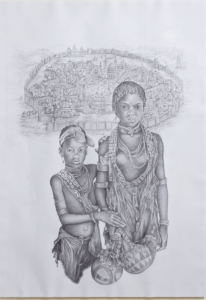
Holyland, Light and Shadow in the Holy Land, Pencil on paper, 2016, Yasmine Bergner
What is the price for not dealing with the Mother Wound?
The price for not dealing with the Mother Wound is to live your life endlessly with:
A vague and constant feeling that “something is wrong with me”
Never realizing your full potential due to fear of failure or lack of acceptance.
Weak boundaries with others and an unclear sense of self.
A sense of worthlessness and an inability to create what you truly desire.
Not feeling “allowed” to take up space and give a voice to your truth.
Organizing your life around “not rocking the boat.”
Self-sabotage when you are on the verge of a breakthrough.
A constant, subconscious expectation waiting for the mother’s approval and acceptance before taking sole responsibility for your life.
What is the connection between the Mother Wound and the Divine Feminine?
There is a broad discourse recently regarding “embodying the Divine Feminine” and becoming an “Awakened Woman.” But the truth is that we cannot be a container strong enough for the power of the Divine Feminine if we have not yet addressed the places within us where we were “expelled” and exiled from the Divine Feminine.
Let’s be honest: our first encounter with “the Goddess” was with our mothers. Until we have the courage to break the taboo and deal with the pain that we experience in the relationship with our mothers, “the Divine Feminine” is just another fairy tale, a fantasy about the mother who does not come to save us. This leaves us in spiritual immaturity. We must separate the flesh-and-blood mother from the archetype in order to become true conductors of this energy. We must dismantle the false structures within us before we can build new and stable structures that we can hold onto. Until we do that, we are stuck in limbo where our empowerment is short-lived and the only explanation for our embarrassing, difficult, and painful situation is to blame ourselves.
If we avoid acknowledging the full impact of the mother’s pain on our lives, we remain, to a large extent, children.
Coming into full power involves looking at our relationships with our mothers and finding the courage to separate our individual beliefs and values from theirs. It involves feeling the grief for the lack of choice to be a witness to the pain that our mothers were forced to suffer, to process our own private, legitimate pain that we suffered as a result. It is so challenging, but this is the beginning of true freedom.
Once we feel the pain, we can transform it and then it will cease to set obstacles in our lives.
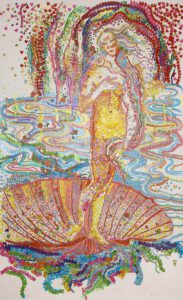
Venus Stickers, Yasmine Bergner, Stickers on paper, 2013
So what happens when a woman heals the Mother Wound?
When we heal the Mother Wound, the power-relationship dynamic gradually fades and balances because women no longer ask each other to remain “small” in order to ease their pain. The pain involved in living in a patriarchal society ceases to be a taboo. We do not have to pretend and hide behind false masks that conceal our pain, under the facade of effortless strength. The pain can then be experienced as legitimate, contained, processed, integrated, and finally—transformed into deep wisdom and power.
Once women begin to gradually process the pain of the Mother Wound, we can create safe spaces for women to express the truth of their pain and receive the deeply needed support. Mothers and daughters can communicate with each other without fear that the truth of their feelings will destroy their relationship. The pain does not need to be hidden underground and inside the shadows, where it manifests as manipulations, competitiveness, and self-hatred. We can mourn our pain so that it can turn into love, love that can turn into fearless support for one another and deep self-acceptance, which will free us to be authentic, creative, and fulfilled in a bold and brave way.
When we heal the Mother Wound, we begin to understand the stunning impact of the mother on the well-being of the child’s life, especially in early infancy where the mother and the child are still one unit. Our mothers pour the foundation from which we develop. Our beliefs start as hers, our habits start as hers. Part of this is so unconscious and basic that it is barely grasped.
The Mother Wound ultimately does not focus on the mother, but is mainly related to learning to embrace and contain yourself and your gifts without guilt.
We address the Mother Wound because it is an important stage in self-realization and saying YES to being a strong and powerful woman, and this is the calling that we are asked to do. The healing focuses on acknowledging and honoring the foundation that our mothers gave to our lives, so that we can focus completely on creating the unique and authentic lives that we desire and know we can achieve.
Benefits of healing the Mother Wound:
We become much more skilled and articulate in managing our emotions. Viewing them as a source of wisdom and knowledge.
We create healthy boundaries that support the realization of our highest self.
We develop and create a stable “inner mother” that provides us with unconditional love, support, and comfort for our younger parts.
We learn to recognize ourselves as capable, competent, and that everything is possible. We are open to miracles and all good things.
We learn to be in constant contact with the inner goodness within us and our ability to bring this goodness into everything we choose to do.
We develop deep compassion toward ourselves and others.
We learn not to take ourselves too seriously, we do not need external validation to feel okay. We do not need to prove ourselves to others.
Learning to trust life to bring us what we need.
Learning to feel safe within our own skin and have the freedom to do what we want.
And much more…
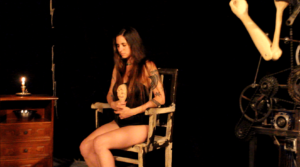
Awakening – In her Savior’s Arms, still from a performance, Experimental Tools Festival 2012,
Artistic director and curator: Gil Alon, Curator: Carmit Blumensohn
Performance documentation: Jude Moskovitch
As we deepen more and more into the healing process, we slowly remove the screen of mist of projections that keeps us stuck, and then we can more clearly see, love, and appreciate ourselves. We no longer carry the burden of our mother’s pain and no longer keep ourselves “small.”
We can reveal ourselves with confidence into our lives, armed with energy and vitality to create what we truly want, without shame or guilt but with passion, power, joy, self-confidence, and love.
For every person, the initial, primordial wound, the primary heart wound was in the presence of the mother, in the presence of the feminine. And through the process of healing the wound, our hearts mature from a state of compromise, defensiveness, and fear, to a whole new level of love and power that connects us to the divine heart of life itself. And from this point on, we are connected to the collective heart archetype, which dwells in the essence of all that exists, and we become carriers and transmitters of compassion and true love that the world needs more than anything right now.
The Mother Wound is actually an opportunity and initiation into the Divine Feminine. This is the reason why it is so important for women to heal the Mother Wound: the personal healing and reconnection to the heart of life, through the feminine, affects the whole and supports our collective evolution.
All rights reserved to Bethany Webster 2014-2016
Translation from English: Yasmine Bergner
Link to the original article:
http://www.womboflight.com/about-the-mother-wound/