

Historical Overview
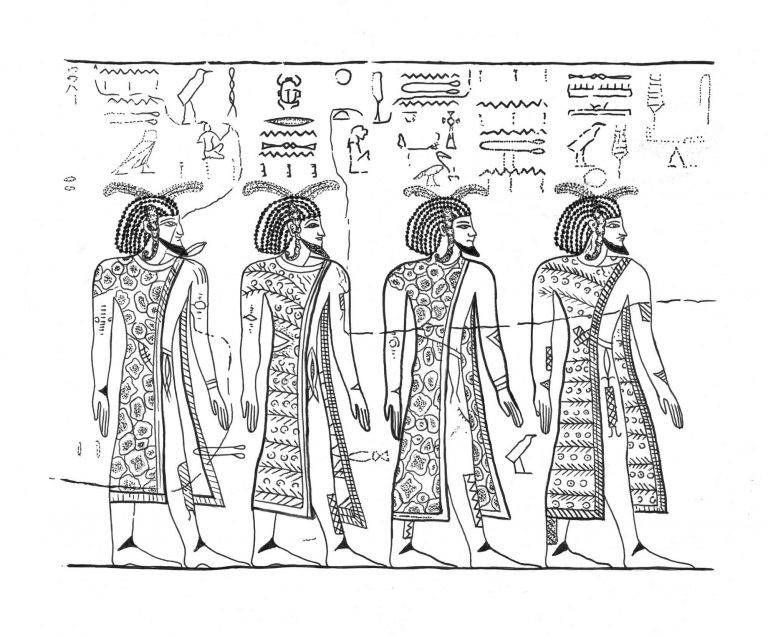
Opening Image: Tattooed slaves on a wall in the Temple of Seti I, Egypt, relief. Drawing: Yasmine Bergner
From the exhibition book “Tattoos – The Human Body as a Work of Art,”
research and curation: Yasmine Bergner, Eretz Israel Museum (MUZA), 2016–2017
The practice of body adornment may date back as far as 100,000 years ago, or even earlier. Shells and bone tools discovered in [1] Blombos Cave (today in the region of South Africa) were found containing remnants of pigment made from red ochre. Archaeologists believe the cave served as a workshop for preparing pigments. This likely represents evidence of technology, artistic production, symbolic thinking, and language during the Middle Stone Age.
It is very possible that the ochre was used for body painting and that the shells functioned as tattooing tools [2]. In the Kid Cave [3] (Es-Skhul Cave) on the Carmel coast and in Qafzeh Cave in the Galilee, caves of a similar character were discovered and attributed to the Mousterian hunter-gatherer culture, dated to the same period and possibly even earlier. In these caves, Homo sapiens bones were found buried together with animal bones, tools, and shells. Large pieces of ochre were also discovered in this cave, brought from other regions and believed to have been used for body or burial decoration.
Across Africa, extensive practices of scarification and tattooing existed, as well as practices combining both, creating a type of raised tattoo. Colonial interventions during the 20th century led to a significant decline in these traditions. As in other parts of the world, missionary activity and Christian imperialism suppressed traditional indigenous arts.
Traditional tattooing and scarification practices still exist throughout Africa, such as in Ethiopia, Cameroon, Mali, Congo, Benin, Mozambique and more [4]. In various Mesopotamian cultures, clay figurines bearing body paintings made with the common ochre pigment have been discovered. Sometimes the female figures show incisions on the body, which can be interpreted as expressions of body art.
In the exhibition “Tattoos – The Human Body as a Work of Art,” three female figurines (in the photo below, in the middle display case) are presented, likely fascinating remnants of these ancient local cultures. The Yarmukian culture was an important local culture that existed about 8,000 years ago during the Pottery Neolithic period and was probably the first in our region to use ceramics. Among the many fertility figurines discovered at the archaeological site of Sha’ar HaGolan, a clay figurine with body incisions on one of its legs was also found. The chalice symbol (the goddess holding a churn in the middle display case) is also one of the prominent symbols of the ancient Great Goddess cultures that filled the globe between approximately 30,000 and 5,000 years ago.
Photographs: Dr. Lars Krutak, tattoo anthropologist
Display case: Right: Goddess figurine, Yarmukian culture.
Center: Goddess holding a churn (the Megiddo woman),
Left: The Revadim figurine
Courtesy of the Israel Museum, Jerusalem
Special thanks to Dorit Shafir, Chief Curator of the Department of Ancient Cultures

Tattoos – The Human body as a work of art
Eretz Israel Museum, Tel Aviv Curator: Yasmine Bergner 2016-2017
Exhibition View, Photo: Leonid Padrul
A unique figurine type was found in several locations in the Land of Israel. The Revadim figurine depicts a female figure with a tormented expression, her hands placed near her genital area. She is nursing twins who suckle from her breasts, and on her neck appears the symbol of the moon. On her thighs are engraved animals and palm trees. It is believed that this figurine served as a protective amulet for women giving birth (possibly of twins). The animals and palms likely serve as a visual reminder of sacred sexuality, fertility, and domestic harmony.
It is assumed [5] that in the cultures of the ancient Near East, the woman and the tree were intertwined symbols, since both the woman and the tree bear fruit and were therefore objects of reverence and worship as feminine deities. Parchia Beck [6] notes that the placement of the decorations on the thighs resembles tattooing customs common in nearby Neolithic cultures and in ancient Egypt, where thigh tattooing was very common, suggesting that these may indeed represent tattoos.
The special symbols on the figurine – the moon, the goats, the palm trees, the act of breastfeeding, and the vulva – indicate that the figurine most likely belongs to one of the ancient Goddess cultures of our region thousands of years ago and tell the story of a deep connection to the earth and the perception of the planet as a nurturing mother.
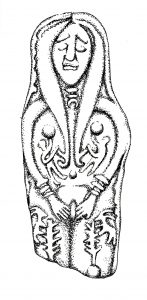
Goddess figurine nursing twins, Revadim,
Drawing: Yasmine Bergner after Perchia Beck
In the Middle East and in the Land of Israel, tattoo cultures existed among Muslim communities, particularly among women. Tassi [7] notes that Egyptian women dyed their hands and the area around their mouths with small blue dots, pricking themselves with needles and rubbing charcoal into the wounds. Edward Lane (1860) wrote during his stay in Egypt that women from the lower classes tattooed their faces with blue designs, usually on their chins and foreheads, but also on the backs of their hands, their arms, their feet, and the center of their chest. Dots, circles, and simple lines were common.
Tattoos played a role in defining the individual and maintaining the continuity of social relationships and social units. Blackman [8] (1937) wrote that indigo and charcoal have antiseptic properties that helped prevent infections. Medicinal herbs such as clove or white beet leaves were also used after the tattoo was completed to strengthen the design and reduce swelling of the skin.
Tattoo traditions also existed among Bedouin communities throughout the Middle East, although conservative interpretations of the Qur’an regarding the practice, along with fundamentalist political influences, led to the suppression and significant reduction of tattoo culture among Muslims today in North Africa. In the Islamic Hadith, it is argued that tattooing harms the spiritual integrity before God. It is claimed that tattoos prevent water from penetrating the skin during purification rituals, one of the five fundamental principles of Islam. Nevertheless, tattoo culture survived for centuries within Islamic cultures in North Africa. In Morocco, for example, collections of popular prayers that included quotes from the Prophet Muhammad determined that tattoos between the eyebrows and on the cheeks were “traditional” and therefore legitimate.

Drawing: Yasmine Bergner after Thomson
The Byzantine physician Aetius described in the 6th century in his medical work TETRABIBLON the method of performing tattooing and even provided recipes for preparing pigment and methods for removing tattoos, for example in cases of freed slaves who had been tattooed on their faces [9]. Levy [10] writes that during the spread of early Christianity into the Mediterranean basin, it began a missionary process among ancient pagan communities who practiced tattooing. This created an ambivalent attitude toward tattooing in Christianity. In the 8th century, Christian monks in Egypt began tattooing symbols belonging to the Coptic tattoo tradition on their bodies. The inspiration for this practice may have come from their neighbors, the Ethiopian Copts, who tattooed their faces and arms. He mentions the earliest documentation of a Jerusalem Cross tattoo on the arm of a European pilgrim, the German knight Alexander von Peppenheim, during his journey to the Holy Land in 1653–4. A Jaffa Arab tattooed a small cross on him for which he paid one medin. Those who usually performed pilgrim tattoos were translators (known as dragomans). This profession fulfilled the need for translation in a region rich in intercultural encounters like the Middle East. They became permanent residents in Jerusalem and Bethlehem, served as guides for pilgrims, and tattooed pilgrimage tattoos, especially during Easter.
By the 17th century, the reputation of the Jerusalem tattoo had already spread far and wide and was documented in travel literature about the Holy Land. In the 18th century historical documentation on tattooing decreased, but in the second half of the 19th century sources again multiplied describing the custom of pilgrimage tattoos, as missionaries, pilgrims, and curious travelers noticed the phenomenon gaining renewed popularity during their visits to Jerusalem. The French traveler Charem recounted in 1880 that he was tattooed with the symbol of the Jerusalem Cross in the Old City by Francis Souben. In Souben’s shop he found about 200 framed recommendations, including one stating: “This is to certify that Francis Souben tattooed the Jerusalem Cross on the arm of His Royal Highness the Prince of Wales” (son of Queen Victoria and later King Edward VII). The Jerusalem Cross also adorned the arm of the Duke of York, later George V, as well as the Prussian Crown Prince Frederick (later Emperor Frederick III) in 1869 [11].
John Carswell visited Israel in 1956 and wrote a book on the Coptic tattoo [12] after visiting the tattoo studio of the long-established Razzouk family, who have been tattooing pilgrimage tattoos in the Old City since the 17th century. These tattoos expressed religious devotion and also served as a symbol of religious belonging, and probably symbolized identification with the stigmata wounds of Jesus. The pilgrimage tattoo is a phenomenon unique to the Land of Israel and is created using a unique technique in which the tattoo is transferred to the skin using beautifully carved wooden stamps featuring complex Christian iconography. The preserved printing blocks allow us to understand the meaning of the symbols and their frequency among pilgrim tattoo bearers. The invention of the modern electric tattoo machine replaced the manual hand-poking technique, but the use of the ancient tattoo patterns has been preserved.
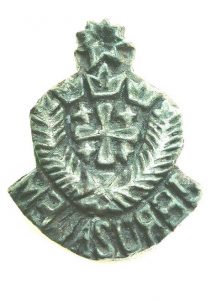
Wooden tattoo stamp images: Courtesy of Wassim Razzouk
An unusual pattern in Carswell’s catalog (52a) presents the Hebrew inscription “Jerusalem”. Part of the Temple Mount plaza can be seen, and in the foreground the location of the Western Wall is hinted at. Mordechai Levy believes that the presence of this pattern among Coptic tattooists suggests that Jews may also have desired tattoos. He finds support for this hypothesis in the memoirs of the English tattooist George Burchett, who deserted the British Navy in his youth while his ship was anchored in Jaffa. When he arrived in Jerusalem, probably in the early 1890s, he opened a small tattoo stand near the Church of the Holy Sepulchre.
Burchett recounts that “The Holy City has been the center of tattooing for fifty years. Tattooists from among the Greeks, Maronites, Syrians, French, Jews and Italians worked there. The tattooists in Jerusalem were fully occupied tattooing pilgrims and tourists.” [13]
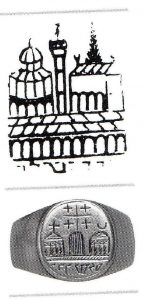
A pattern bearing the inscription “Jerusalem”
From: John Carswell, Coptic Tattoo Designs, Beirut:
American University of Beirut, 1958
The practice continues to this day among Kurdish communities in northern Iraq and southern Turkey, and its origins are likely connected to Balkan tattoo traditions. In Iraq, until around 1930, both men and women were tattooed with protective and healing tattoos, as well as tattoos intended to enhance beauty. Women were most often the tattooers, and the ink was prepared by mixing soot and breast milk. The designs were simple and geometric, and were applied to all parts of the body [14].
In Iraq, female mullahs would conduct joint rituals of prayer and tattooing. The mullah would sit with the tattooer, reciting verses from the Qur’an, transforming the domestic space of the person being tattooed into a sacred space. From this perspective, the tattoo ritual appears as a rhythmic weaving of physical and spiritual patterns, connecting the women – guardians of tradition – with a sacred dimension (El tmk, according to Krutak; Guindi, 1999, p. 86).
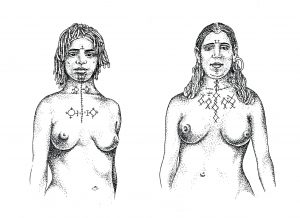
Tattoos in Morocco, 1920. Drawing by Yasmine Bergner, after Haber.
From The Tattooing Arts of Tribal Women by Lars Krutak
This intimate space, created through the sacred words of the Qur’an and the baraka (blessing) embodied in the tattooist’s professional practice – through her intricate designs and healing pigments -generated an unforgettable collective experience. It became sacred for all those present through the rhythmic repetition of prayer and tattooing, word and action [15].
Rural Berber (Amazigh) communities in Algeria, Morocco, Tunisia, Libya, and Egypt, as well as nomadic groups such as the Tuareg in Mali, maintained a rich tattooing tradition. This practice was rooted in a unique form of Islamic belief that incorporated elements of atavistic animism, including faith in a supernatural force (baraka) and a soul present at the core of all things.
Today, this custom is fading and is mostly visible among elderly women. In the past, children of both sexes received protective tattoos during childhood, especially if a sibling had died. The practice was primarily associated with women, and the tattoos often functioned as protective amulets against evil spirits, as well as symbols of beauty and fertility, and sometimes as preparation for marriage. However, in some of these communities, men were also tattooed [16].
From the exhibition book:
Tattoos – The Human Body as a work of Art
Curator & researcher: Yasmine Bergner
Bibliography:
[1] Blombos Cave, South Africa
[2] Anna Felicity Friedman, World Atlas of Tattoo, Yale University Press, 2015
[3] Bar-Yosef Mayer, Daniella E.; Vandermeersch, Bernard; & Bar-Yosef, Ofer (2009). “Shells and Ochre in Middle Paleolithic Skhul and Qafzeh, Israel: Indications for Modern Behavior.” Journal of Human Evolution, 56, 307–314.
[4] ] Anna Felicity Friedman, The World Atlas of Tattoo, Yale University Press, 2015
[5] Irit Ziffer, “Western Asiatic Tree Goddesses,” Egypt and the Levant, Vol. 20, 2010, pp. 411–430, Austrian Academy of Sciences Press
[6] Pirhiya Beck, “A New Type of Female Figurine,” in Imagery & Representation – Studies in the Art & Iconography of Ancient Palestine: Collected Articles. Authors: Pirhiya Beck, Nadav Na’aman, Zevulun Uza, Irit Ziffer, Tel Aviv University, 2002
[7] Geoffrey J. Tassie, “Identifying the Practice of Tattooing in Ancient Egypt and Nubia,” Papers from the Institute of Archaeology, Vol. 14 (2003), p. 86, UCL Institute of Archaeology
[8] Blackman, Winifred S., The Fellahin of Upper Egypt, London: George G. Harrap & Co. Ltd, 1927
[9] Mordechai Levy, “On the History of Jerusalem Tattooing among European Pilgrims,” Cathedra 95 (Nisan 5760), pp. 37–66, p. 48
[10] Ibid., p. 39
[11] Ibid., pp. 42–45
[12] John Carswell, Coptic Tattoo Designs, Beirut: American University of Beirut, 1958
[13] Burchett, p. 52, cited in Mordechai Levy, “On the History of Jerusalem Tattooing among European Pilgrims,” Cathedra 95, pp. 37–66, p. 66
[14] The World Atlas of Tattoo, p. 216
[15] Lars Krutak, The Tattooing Arts of Tribal Women, Bennett & Bloom / Desert Heart, 2002–2007, p. 39
[16] Ibid., p. 25
Opening image: Tattooed slaves depicted on a wall in the Temple of Seti I, Egypt (relief). Drawing by Yasmine Bergner.
Yasmine Bergner is a multidisciplinary artist, tattooer, therapist and researcher of tattoo culture.